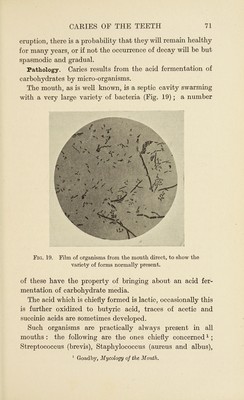
Stomatology in general practice : a textbook of diseases of the teeth and mouth for students and practitioners / by H.P. Pickerill.
- Henry Percy Pickerill
- Date:
- 1912
Licence: In copyright
Credit: Stomatology in general practice : a textbook of diseases of the teeth and mouth for students and practitioners / by H.P. Pickerill. Source: Wellcome Collection.
93/292 page 73
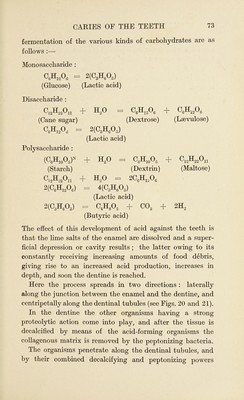
![fermentation of the various kinds of carbohydrates are as follows :— Monosaccharide : ^6^12^6 — = 2(C3H603) (Glucose) (Lactic acid) Disaccharide : ^12^22^11 + H20 = c6h12o6 + CcH1206 (Cane sugar) (Dextrose) (Laevulose) CcH12Od = = 2(C3Hc03) (Lactic acid) Polysaccharide : (C6H10O5)n + H20 = C6H]0O5 + ^12-^-22^11 (Starch) (Dextrin) (Maltose) ^12^22^11 + H20 = 2CcH1A • 2(C6H]206) = 4(C3H603) (Lactic acid) 2(C3H603) = c4h8o2 + co2 + 2H2 (Butyric acid) The effect of this development of acid against the teeth is that the lime salts of the enamel are dissolved and a super- ficial depression or cavity results ; the latter owing to its constantly receiving increasing amounts of food debris, giving rise to an increased acid production, increases in depth, and soon the dentine is reached. Here the process spreads in two directions : laterally along the junction between the enamel and the dentine, and centripetally along the dentinal tubules (see Figs. 20 and 21). In the dentine the other organisms having a strong proteolytic action come into play, and after the tissue is decalcified by means of the acid-forming organisms the collagenous matrix is removed by the peptonizing bacteria. The organisms penetrate along the dentinal tubules, and by their combined decalcifying and peptonizing powers](https://iiif.wellcomecollection.org/image/b28091097_0093.jp2/full/800%2C/0/default.jpg)