An introduction to the theory of mental and social measurements / by Edward L. Thorndike.
- Edward Thorndike
- Date:
- 1904
Licence: In copyright
Credit: An introduction to the theory of mental and social measurements / by Edward L. Thorndike. Source: Wellcome Collection.
88/232 page 72
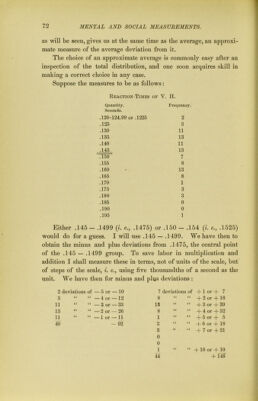
![as will be seen, gives us at the same time as the average, an approxi- mate measure of the average deviation from it. The choice of an approximate average is commonly easy after an inspection of the total distribution, and one soon acquires skill in making a correct choice in any case. Suppose the measures to be as follows: Keaction-Times of V. H. Quantity. Frequency. Seconds. .120-124.99 or .1225 2 .125 3 .130 11 .135 13 .140 11 ^145_ 13 Ti50 7 .155 8 .160 13 .165 8 .170 1 .175 3 .180 3 .185 0 .190 0 .195 ] Either .145 - .1499 (i. e., .1475) or .150 - .154 {i. e., .1525) would do for a guess. I will use .145 — .1499. We have then to obtain the minus and plus deviations from .1475, the central point of the .145 — .1499 group. To save labor in multiplication and addition I shall measure these in terms, not of units of the scale, but of steps of the scale, i. e., using five thousandths of a second as the unit. We have then for minus and plus deviations : 2 deviations of — 5 or — 10 7 deviations of + 1 or 7 3 “ — 4 or — 12 8 L i d- 2 or -(- 16 11 U “ — 3 or — 33 13 U i i + 3 or + 39 13 u “ — 2 or — 26 8 u Li 4 or 32 n i i ‘‘ —1 or — 11 1 (1 ( c -f 5 or + 6 40 * — 92 3 li a + 6 or + 18 3 Li a 4- 7 or -h 21 0 0 1 Li i i + 10 or + 10 44 + 148](https://iiif.wellcomecollection.org/image/b28082370_0088.jp2/full/800%2C/0/default.jpg)