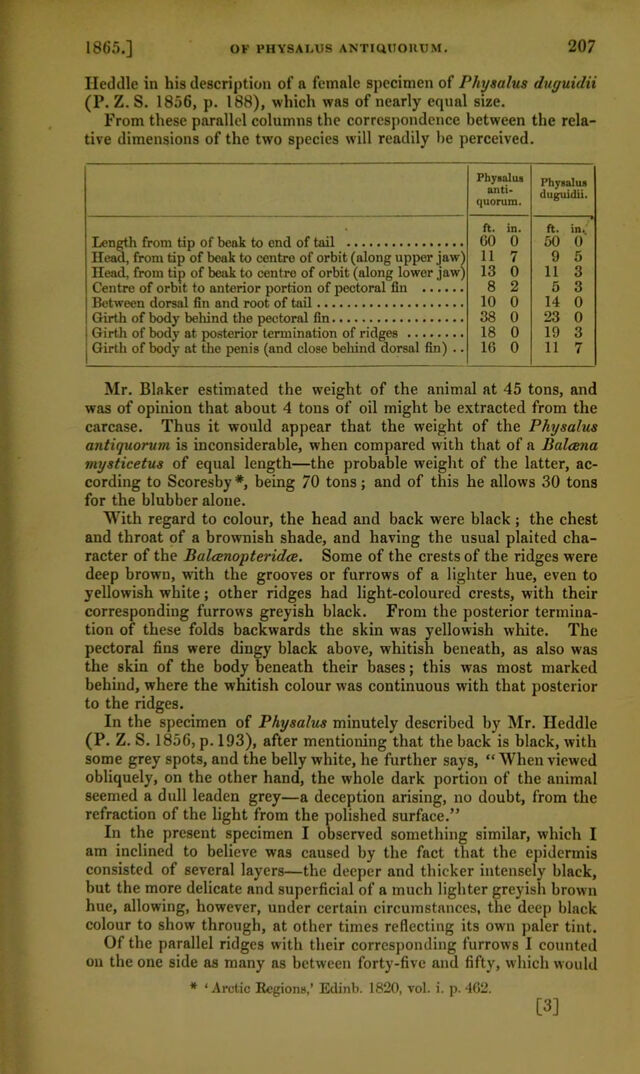
On the anatomy of a fin-whale (Physalus antiquorum, Gray) captured near Gravesend / by James Murie.
- Murie, James.
- Date:
- [1865]
Licence: Public Domain Mark
Credit: On the anatomy of a fin-whale (Physalus antiquorum, Gray) captured near Gravesend / by James Murie. Source: Wellcome Collection.
Provider: This material has been provided by The Royal College of Surgeons of England. The original may be consulted at The Royal College of Surgeons of England.
5/24 page 209
![the mode of distention of the skin of the animnl he dissected (P. Z. S. 1856, p. 192, pi. xuv. f. 8); but these will be found on comparison hardly to show the true manner in which distention is permitted. A similar vertical section through the skin, as deep as the muscle, revealed the small depth of the blubber, from 2 to at most 4 inches, and that between it and the true skin there was scarcely any appre- ciable difference, so intimately and continuously were the fibres inter- woven. The only difference was in the rather w'ider meshes inwardly, the interspaces there containing oil, although in very limited quan- tity. The pectoral fins were flattened, narrow-pointed, and curved; in appearance they were not unlike the figures given by Eschricht* of the fin of Pterobalcena minor (Balcenoptera rostrata, Fab.). In position, and while attached to the body, one measured along the border of the anterior curve 75 inches, and in the posterior mar- ginal curve 57 inches. When cut off, the measurement from the articulation of the shoulder-joint to the terminal point in a direct line was 85 inches. The dorsal fin was falciform, laterally compressed, and erect; its height 15 inches, and its antero-posterior length at the base 13 inches. The tail in extent across to the extremity of either fluke was 133 inches, and its breadth at the root 37 inches. I am not aware that the exact manner in which the tail acts in this tribe of animals is perfectly agreed upon among writers; for although John Hunterf expresses himself to the effect that the mo- tion of the tail is similar to that of an oar in sculling a boat, and again, that from its horizontal position the animal is impelled up and down in the water, thus giving the necessary opportunity of breath- ing, yet Dr. Knox| admits the difficulty in understanding the mode of progression, and further states that this takes place by a series of bounds, caused by the spring of the incurved tail, the immense strength of the flexors and extensors giving it such a counter force against the water as to impel the animal along and upwards accord- ing to circumstances. That each of these mechanical applications of the tail to certain motions does take place is more than likely, although at first it does not seem so very clear how the mere flapping of a horizontal tail produces a steady onward gliding movement, which no doubt occurs without the necessity of continually rising and falling in the water. The Sperm Whale, according to Beale§, “ when undisturbed, passes tranquilly along just below the surface of the water, at the rate of about three or four miles an hour, which progress he effects by a gentle oblique motion from side to side of the ‘ flukes,’ precisely in * Untersuchungen uber die Nordischen Wallthiere, 1849, tab. 8. figs. 1, 2. t ‘ Observations on the Structure and Economy of Whales,’ Palmer’s edition of his works, 1837, vol. iv. p. 331. I ‘ Cat. Prep, of Whales,’ No. 4. I am indebted to the kindness of Dr. Gray for a perusal of this scarce pamplilet, which contains much information on the anatomy of Cetacea. § ‘ Nat. Hist, of the Sperm Whale,’ p. 39. F. [5]](https://iiif.wellcomecollection.org/image/b22352089_0007.jp2/full/800%2C/0/default.jpg)