Licence: In copyright
Credit: The overtrained nurse / by W. Gilman Thompson. Source: Wellcome Collection.
Provider: This material has been provided by The Royal College of Surgeons of England. The original may be consulted at The Royal College of Surgeons of England.
12/18 page 10
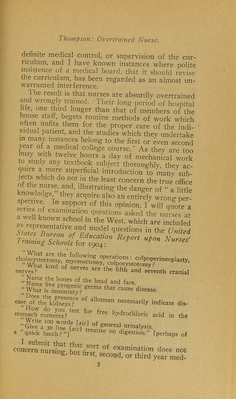
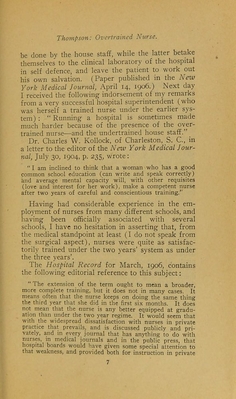
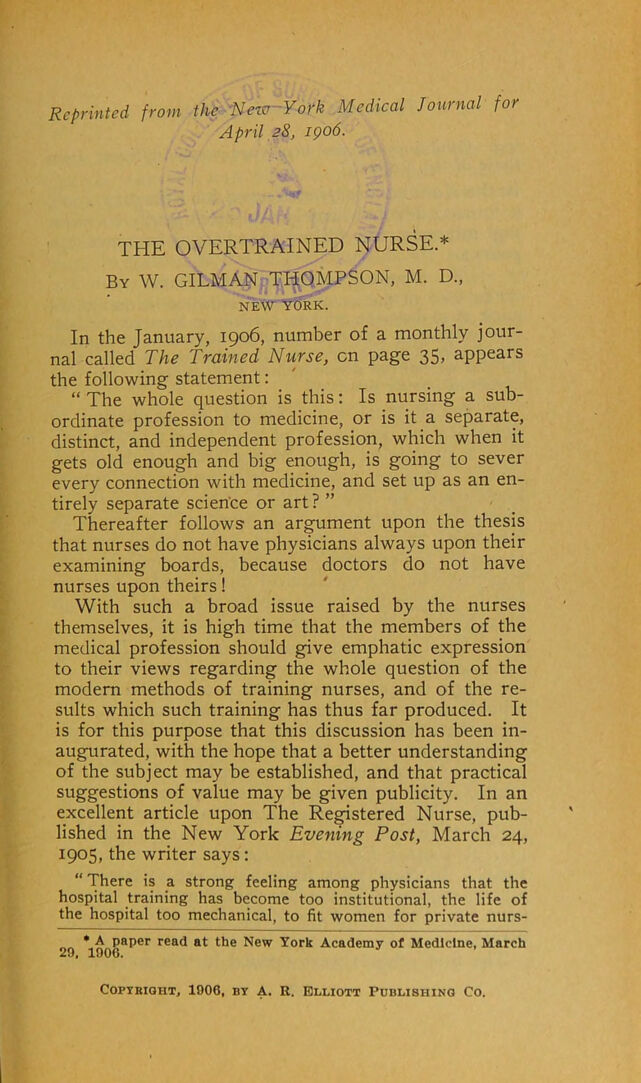
![“ The nurses of the Empire State are not in the sweetest accord; their organizations have not as yet effected that complete harmony and union that should exist among mem- bers of a trained profession finer]. It is so in other States.” The bill recently introduced in the New York Legislature (Senate Bill No. 462) to establish a State Commission for the regulation of the practice of nursing, would, if enacted, prove a decided boom- erang for nurses, and teach the folly of rushing into legislation with such a simple matter as nursing. In a paragraph in a late number of the Journal ofi the American Medical Association, headed “The Battle of the Nurses,” it is pointed out that the ques- tion of parliamentary registration of nurses pro- duced a secession from the ranks of the Royal Brit- ish 'Nurses’ Association, with formation of a new Society for the State Registration of Nurses, the main source of dispute being the question of the extent of control of the examining board by physicians. The most serious feature of the State examination of nurses as at present conducted is found in the fact that, being for the most part a written and oral (not bedside) examination, it is even less a test for fitness to practice nursing than the similar regents’ examination is an adequate test of the fitness of physicians to practise medicine. I have served on training school examining boards for twenty years in different hospitals, and testify that the very best nurses may sometimes pass the poorest written and oral examinations. In a discussion upon this topic at a meeting of the German Association for Public Health, Professor Petersen, of Kiel, said: “ that he was opposed tc the proposed examination of nurses. One of the most desirable qualifications of a nurse was a kind and sympathetic disposition, and this could not be ascertained by a State license. He had often observed that very good probationers had failed in an examination. Moreover, a nurse might be extremely competent in a special branch of nursing, although unfitted for ordinary nursing. For these specialists a general examination would mean](https://iiif.wellcomecollection.org/image/b22431032_0014.jp2/full/800%2C/0/default.jpg)