Report on an investigation as to the housing conditions, with a discussion on their correlation with the chief vital statistics and some notes on town planning / A. G. Anderson.
- Anderson, A. G.
- Date:
- 1911
Licence: In copyright
Credit: Report on an investigation as to the housing conditions, with a discussion on their correlation with the chief vital statistics and some notes on town planning / A. G. Anderson. Source: Wellcome Collection.
Provider: This material has been provided by London School of Hygiene & Tropical Medicine Library & Archives Service. The original may be consulted at London School of Hygiene & Tropical Medicine Library & Archives Service.
151/180 (page 125)
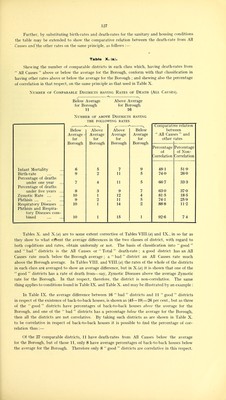
![By referring to Chart No. 1 it will be found that with one exception (C.X.2), the 16 districts with high rates set out in Table VII have all percentages of Back-to-back houses Two-roomed houses Houses with low rents, and Houses with Joint Closet Accommodation which are above the average percentage for the Borough, and that with three exceptions (W.7, W.IO and W.15) the 16 districts have percentages of Houses in Poor condition above the average percentage for the Borough. The most frequent exception, it should be noted, is sub-district C.N.2, bounded by South Parade, Drake-street, Great George-street, School-lane, Church Steps and Packer-street—a district where many old houses have been demolished during the period covered by the Vital Statistics, and which originally would have appeared above the averages. In sharp contrast with the conditions in the 16 districts with high rates are those existing in the 11 districts with low rates. In all save three (S.N.8, C.N.6, and C.N.13) the percentage of Back-to-back houses is below the average percentage for the Borough; in all save two (S.N.8 and C.N.6) the percentages of Two-roomed houses, and Houses with low rents are below the average percentage for the Borough ; in all save two (C.N.I and C.N.6) the percentage of Houses in Poor Condition is below the average percentage for the Borough; and in all save four (S.N.8, S.N.3, C.N.5 and C.N. 6) the percentage of Houses with Joint Closet Accommodation is below the average percentage for the Borough. The first point thus established in a general way is, that, with regard to the Housing and Sanitary conditions of the sub-districts under consideration, and shown on Chart No. 1, those conditions in which the two classes of sub-districts, viz. :—[a] districts having high death-rates ; and [b] districts having low death-rates, differ in the highest degree are— (1) Back-to-back houses (2) Two-roomed houses (3) Low-rented houses (4) Houses in Poor Condition (5) Houses with Joint Closet Accommodation, and by following, on Chart No. 1, the column for each of these districts, the extent to which they differ in respect of the conditions may be ascertained. A general survey of Chart No. 2 will be sufficient to show that the average number of persons inhabiting two-roomed houses (which are nearly all of the back-to-back type), is nearly as large as that for four-roomed houses, which have twice the bedroom accommodation ; and consequently that the ascertained overcrowding rate in two-roomed houses is enormous compared with that of four-roomed houses. Therefore, the list of conditions in which the two classes of districts differ greatly, must accordingly be extended as follows :— (6) Domestic overcrowding. The extent to which the districts differ from each other and from the whole of the districts in the Borough, on the average is as follows :—](https://iiif.wellcomecollection.org/image/b21364308_0151.jp2/full/800%2C/0/default.jpg)