Specialism in medical teaching and examining / by Thomas Cooke.
- Cooke, Thomas, 1841-1899.
- Date:
- 1897
Licence: Public Domain Mark
Credit: Specialism in medical teaching and examining / by Thomas Cooke. Source: Wellcome Collection.
Provider: This material has been provided by The Royal College of Surgeons of England. The original may be consulted at The Royal College of Surgeons of England.
15/28 page 13
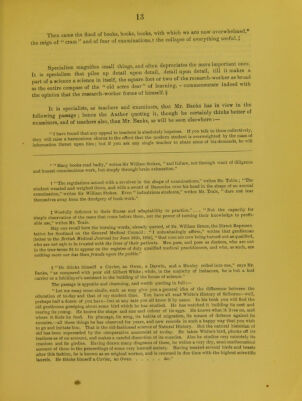
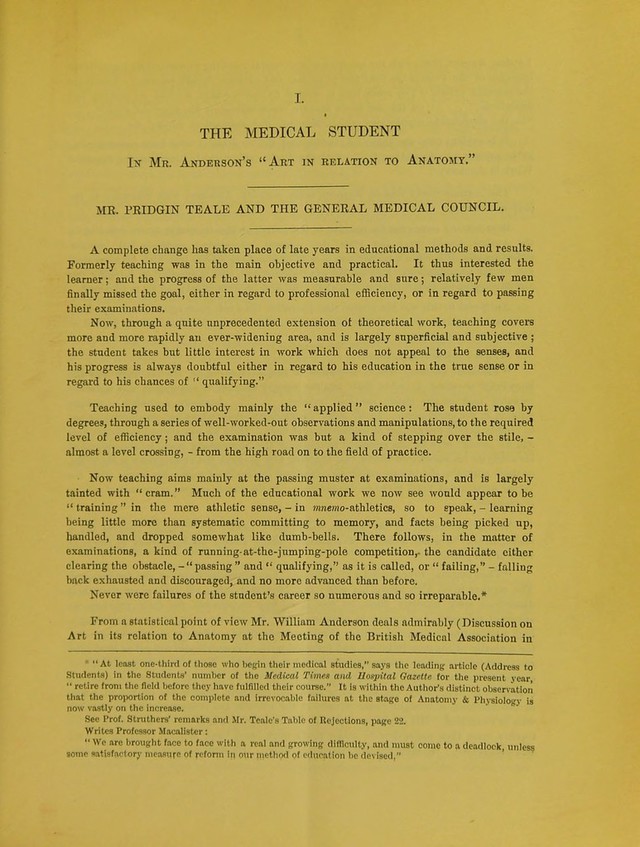
![Then came the flood of books, books, books, with which wc are now overwhelmed* * * § the reign of “ cram ” and of fear of examinations,! the collapse of everything useful. + Specialism magnifies small things, and often depreciates the more important ones. It is specialism that piles up detail upon detail, detail upon detail, till it makes a part of a science a science in itself, the square foot or two of the research-worker as broad as the entire compass of the “ old acres dear” of learning, - commensurate indeed with the opinion that the research-worker forms of himself. § It is specialists, as teachers and examiners, that Mr. Banks has in view in the following passage ; hence the Author quoting it, though he certainly thinks better o examiners, and of teachers also, than Mr. Banks, as will be seen elsewhere “ I have found that any appeal to teachers is absolutely hopeless. If you talk to them eollectiv ely, they will raise a harmonious chorus to the effect that the modern student is overweighted by the mass o information thrust upon him ; but if you ask any single teacher to abate some of his demands, he * “ Many books read badly,” writes Sir William Stokes, “ and failure, not through want of diligence and honest conscientious work, but simply through brain exhaustion. ’ t “The regulations anned with a revolver in the shape of examinations,” writes Mr. Tobin ; “The student wearied and weighed down, and with a sword of Damocles over his head in the shape of an annual examination,” writes Sir William Stokes. Even “ industrious students,” writes Mr. Teale, dare not tear themselves away from the drudgery of book-work.” 1 Woefully deficient in their fitness and adaptability to practice.” . . , “ Not the capacity for simple observation of the cases that come before them, not the power of turning their knowledge to profit- able use,” writes Mr. Teale. „ . _ May one recall here the burning words, already quoted, of Dr. William Bruce, the Direct Represen tative for Scotland on the General Medical Council: »I unhesitatingly affirm,” writes that gentleman [letter to the British Medical Journal for June 16th, 1894], “ that men are now being turned out as qualified, who are not safe to be trusted with the lives of their patients. Men pass, and pose as doctors, who are not. in the true-sense fit to appear on the register of duly qualified medical practitioners, and who, as such, are nothing more nor less than frauds upon the public.’’ § He thinks himself a Cuvier, an Owen, a Darwin, and a Huxley rolled into one,” says Mr. Banks, “as compared with poor old Gilbert White; while, in the majority of instances, he is but a hod carrier or a bricklayer's assistant in the building of the house of science. The passage is apposite and charming, and worth quoting in full “ Let me essay some simile, such as may give you a general idea of the difference between the education of to-day and that of my student time. You have all read White’s History of Selborne—well, perhaps half a dozen of you have—but at any rate you all know it by name. In his book you \\ ill find the old gentleman gossiping about some bird which he has studied. He has watched it building its nest and rearing its young. He knows the shape and size and colour of its eggs. He knows what it lives on, and whereat finds its food. Its plumage, its song, its habits of migration, its means of defence against its enemies,—all these things he has observed for years, and now records in such a happy way that you wish to go and imitate him. That is the old-fashioned science of Natural History. But the natural historian of old has been superseded by the comparative anatomist of to-day. He takes White s bird, plucks off its feathers as of no account, and makes a careful dissection of its muscles. Also he studies very minutely its cranium and its girdles. Having drawn many diagrams of these, he writes a very dry, semi-mathematical account of them in the proceedings of some very learned society. Having treated several birds and beasts after this fashion, he is known as an original worker, and is crowned in due time with the highest scientific laurels. He thinks himself a Cuvier, an Owen ..... &c.” *](https://iiif.wellcomecollection.org/image/b22397437_0017.jp2/full/800%2C/0/default.jpg)