Specialism in medical teaching and examining / by Thomas Cooke.
- Cooke, Thomas, 1841-1899.
- Date:
- 1897
Licence: Public Domain Mark
Credit: Specialism in medical teaching and examining / by Thomas Cooke. Source: Wellcome Collection.
Provider: This material has been provided by The Royal College of Surgeons of England. The original may be consulted at The Royal College of Surgeons of England.
17/28 page 15
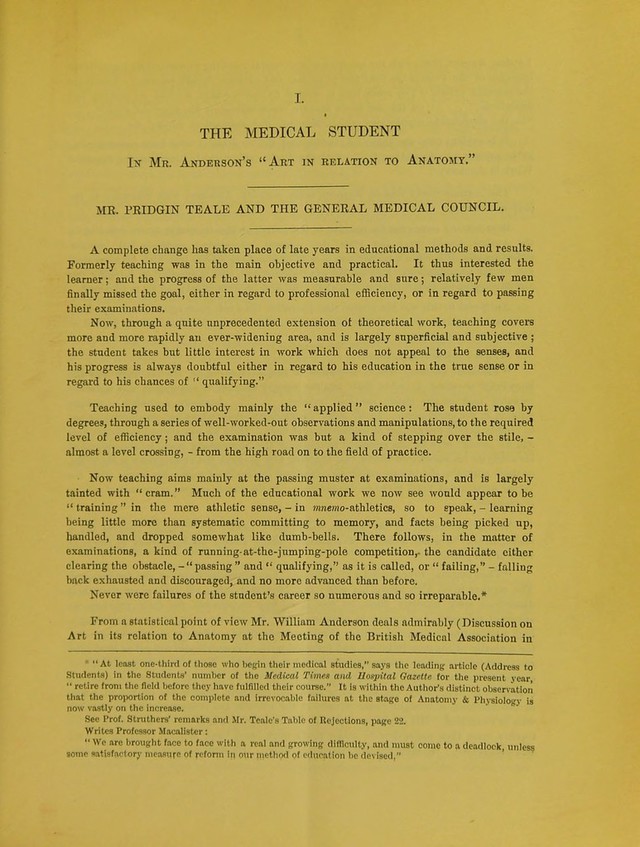
![COMPULSION; PERSUASION. Summing up will emphasise the leading points. It is not the object, however, of the Author to deal with medical politics. It is for principles only that he seeks to gain acceptance, and examples only that he seeks to adduce. He gives the views of others,-of Leaders,-not his own. He quotes; but, except on one or two points, he attempts no conclusions:— “Students . . . . woefully deficient in their fitness and adaptability to practice ; . . . . not the capacity for simple observation of the cases that come before them, nor the power of turning their knowledge to profitable use,” writes Mr. Teale. “Their whole learning has vanished in a few months;” “steadily deteriorating;” “harassed,” “vacuus studens,” writes Mr. Mitchell Banks. “I unhesitatingly affirm,” writes Dr. William Bruce, the Direct Representative for Scotland on the General Medical Council, “that men are now turned out as qualified, who are not safe to be trusted with the lives of their patients. Men pass and pose as dootors, who are not, in the tine sense, fit to appear on the register of qualified medical practitioners, and who, as such, are nothing more nor less than frauds upon the public.” Dr. McVail, Crown Member of the General Medical Council, addressing the Council:— “ It is a most remarkable thing that the representative of should tell us at this time of the day, and after all that has been done to establish a satisfactory Curriculum, that the candidates who go up for the College examinations cannot be up in medicine, surgery, and midwifery at the end of five years of study, and must be allowed to take each subject separately, - that is, to come back for examination in medicine after passing in surgery, and in midwifery after passing in medicine.” Very just demands have been put forward of late for the extension of medical education in various directions, e.g., in practical midwifery and in bacteriology. In both directions the most praiseworthy efforts have been nugatory. Why? Because “The student has come to the bursting point,” writes Mr. Mitchell Banks. (The entire passage is quoted on page 3 of the accompanying leaflet.) “Unless the student knows that he will have his knowledge of any branch of the profession tested at the examination table,” writes Mr. Arbuthnot Lane, “ he cannot be relied upon to make himself familiar with its details.” “ The reason is not far to seek, adds Dr. Washbourn : “ the bulk of students will only attend courses which are either compulsory, or which will directly assist them in passing their examinations. They fear wasting their time on subjects which do not ‘ pay.’ ” Too much is being forced ou the student; and the important distinction is neglected between [1] knowing in the sense of merely remembering what one may have been told, or may have seen more or less casually, - (such “ communicated ” knowledge ever remains, so to speak, something outside one),-and [2] knowing through having found out or verified by one’s own discrimination, by the active exercise of one’s own senses, by one’s own effort, - (such knowledge - true knowledge, it might be termed - becomes a permanent part of one’s nature). It is only the passive process that can be subjected to definite and multiple codification, such as now prevails. The active process, the vital process, which](https://iiif.wellcomecollection.org/image/b22397437_0019.jp2/full/800%2C/0/default.jpg)