Specialism in medical teaching and examining / by Thomas Cooke.
- Cooke, Thomas, 1841-1899.
- Date:
- 1897
Licence: Public Domain Mark
Credit: Specialism in medical teaching and examining / by Thomas Cooke. Source: Wellcome Collection.
Provider: This material has been provided by The Royal College of Surgeons of England. The original may be consulted at The Royal College of Surgeons of England.
5/28 page 3
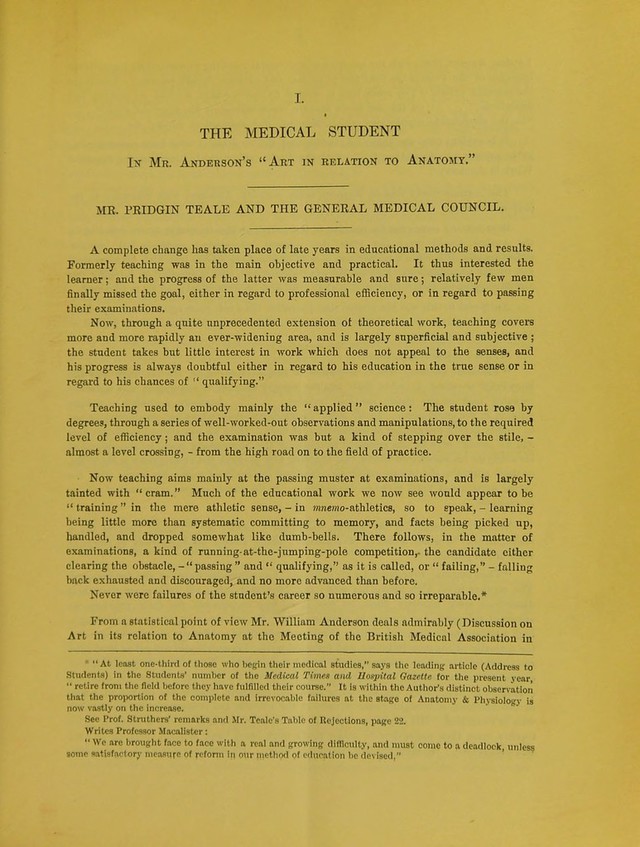
![Nolens volens, lie becomes n ‘coach,’an employ6 paid to get men through their examina- tions ; one soon considered to be in the pay of the men ; one whose humble duty it is to obev the constant cry, ‘ Give ns a grind on this part and on that;’ one who is to be a walking book to save the men the trouble of reading, who is to follow in the fads of the dav, who is to be led ; - not one who is to lead. The rest follows. The high example is lost; the standards are lowered; the floodgates of demoralisation are opened. ‘ Cram reigns snpreme everywhere and from beginning to end, none deploring the course of events more than the most earnest teachers themselves.” What we have now corresponds to the forced hot-house growth fitted for immediate consumption or temporary decoration, - not the sturdy natural vegetation of permanent fruit-bearing capabilities. We look to the “ turn out ” made “ to sell,” not to the honest home product. Is this wise where such responsibilities are involved?* What is wanted, in. regard to Anatomy, is a return to the simplest, plainest “common or garden Anatomy,” as some call it disparagingly, but taught a la Ellis, and in the spirit of Professor Macalister’s remarks : our one standard should he the human body THOROUGHLY dissected BY THE STUDENT. And this should involve no prejudice to the study of scientific Anatomy. It is submitted, however, that the two objects are unrealizable together by the older methods of dissecting, adapted, as they are, to a two or three years’ course of little but human Anatomy. The Author would not willingly exult over gains, even in the direction in which he has worked his hardest and best for many long years, but lie would submit that the double object is easy of attainment by the methods of the “ Dissection Guides ” referred to at the end of the volume of Tablets, - the distinction between, and separation of, two things essentially different (theoretical Anatomy and practical Anatomy) being once admitted, which is pressed for throughout the said volume. §■ One thing the Author knows, and asserts most emphatically, on the strength of long experience - namely, that it is easy to get the average youth fresh from school to take an interest - indeed, an intense interest - in Anatomy, as taught practically, and as answering his “ questioning cogitations, nnformulated perhaps, but none the less real, as to ‘ how the thing works.’”f It is but a truism to put it that the main object of education is to maintain and expand such interest, - the mainspring of all success, be it remembered, whether to the student or to the future practitioner, - and to apply the same in 1 Too much is being done for the student; and the important distinction is neglected between [1] knowing in the sense of merely remembering what one may have been told, or may have seen more or less casually, - (such “ communicated” knowledge ever remains, so to speak, something outside one), - and (2| knowing through having found out or verified by one’s own discrimination, by the active exercise of one's own senses, by one’s own effort., - (such knowledge - true knowledge, it might be termed - becomes a permanent part of one’s nature). It is only the passive process that can be subjected to definite and multiple codification, such as now prevails. The active process, the vital process, which alone, it is averred, has value, is impeded, or altogether inhibited by over-regulation. True knowledge is not a finest ion of “ remembering;” it is a cpicstion of ingrained mental and moral reflex action. 1 “ \\ hat is the primary want of the physician or surgeon in regird to Anatomy ? Is it not to acquire visual and manual familiarity with the human frame? Is it not to know, in the sense of almost seeing through, and, as far as needs be, of dextrously handling throughout, the individun man, woman, or child](https://iiif.wellcomecollection.org/image/b22397437_0007.jp2/full/800%2C/0/default.jpg)