Specialism in medical teaching and examining / by Thomas Cooke.
- Cooke, Thomas, 1841-1899.
- Date:
- 1897
Licence: Public Domain Mark
Credit: Specialism in medical teaching and examining / by Thomas Cooke. Source: Wellcome Collection.
Provider: This material has been provided by The Royal College of Surgeons of England. The original may be consulted at The Royal College of Surgeons of England.
6/28 page 4
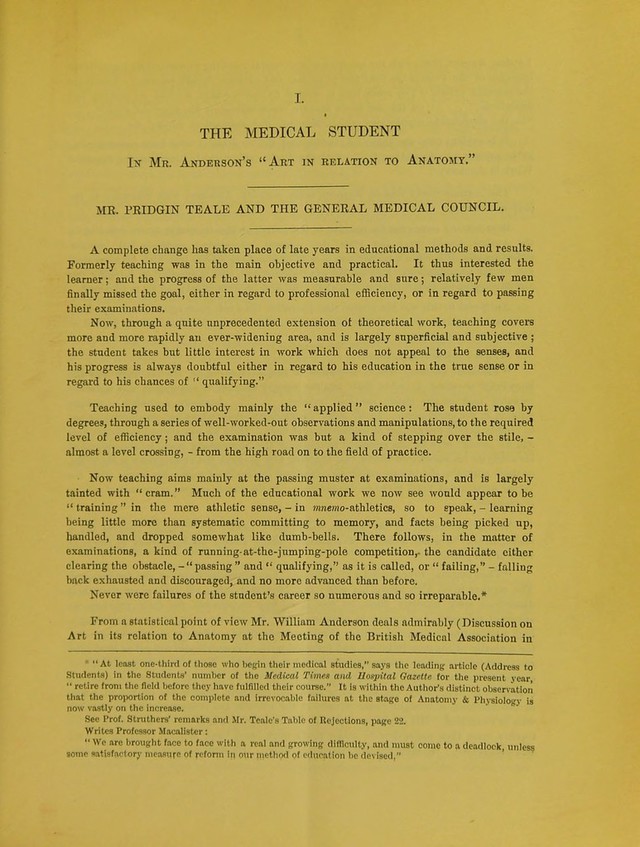
![succession to every branch of the Curriculum. A favourable beginning - with Anatomy taught as above-is at least a good start in the paths of medical study. §• Honest training or true knowledge is much in the nature of drill. In an applied science, knowledge is not so much an aim in itself, as of value in that it expands into applications and developments. Knowledge must yield her increase in the very hands of the learner. Now in Anatomy all merely abstract or theoretical knowledge is sterile of applications and developments. The man who knows about Poupart’s and Gimbernat s ligaments, the femoral vessels and the spermatic cord, in the true way, - i.e., from repeated actual dissections, - will do the right thing unhesitatingly in a case of hernia. But the man is paralysed, and must remain incapable all the days of his life, who has to look up to the ceiling before he can make sure of the whereabouts of the rings, or of the the epigastric artery or the vas deferens. What is drill ? The soldier on the battle-field is not necessarily, as a man, a braver man, - that is, a man naturally less influenced by danger, - than other men ; but the point is that his mental acts and his emotions respond fully and surely in a pre-determined fashion to the position before him. So it should be with the surgeon, if he has been properly drilled. If he has not, he will never be equal to the emergencies that are hound to present. Mere theoretical knowledge fails through being devoid of the element of aril/. Medical men should be drilled in practical Anatomy. Por their needs, Anatomy should be learnt all hut entirely by dissecting. §• The view must be strenuously controverted that recent advances in surgery are in any w?v connected with the form of Anatomy now being pressed to the front. To such view the Author would oppose the direct negative (distinctly supported by weighty evidence adduced elsewhere), that the falling-off in surgery, so noticeable of late except in the hands of the few, is the result of modern educational programmes.* * The adoption here of the method of argument of a well-known citizen of ancient Borne, whose every utterance wound up with, in some form or other, “ Delenda est Carthago,” will, besides relieving a paper already long, best meet the requirements of he is auscultating or percussing, or whose unconscious form lies under his knife on the operating table ? What is it that will give him practical insight into the actual case before him, quickness in under- standing its bearings, fertility of resource in dealing with its requirements? Is it not mainly the trained hand that makes straight for the right osseous projection, the educated finger accustomed to the feel of this structure and of that, the sharp eye familiar with the most insignificant guide-point, and which recognises at once a little bit of an exposed tendon, or a certain small nerve, or a thin muscular plane What serves morphology here ? ”—(Plea, p. 302. * “ The case might rest on the weighty words of a Member of the General Medical Council, Dr. William Bruce, the direct representative for Scotland. ‘ I unhesitatingly affirm,’ writes that gentleman [letter to the British Medical Journal for June 16th, 1891], ‘ that men are now being turned out as qualified, who are not safe to he trusted with the lives of their patients. Men pass, and pose as doctors, who are not in the true sense fit to appear on the register of duly qualified medical practitioners, and who, as such, are nothing more nor less than frauds upon the public.’ General practitioners are complaining of Hospital competition. Why is this? “Patients crowd the out-patients’ rooms of an infirmary, or else place themselves under bone-setters or sham oculists, for opera- tions that should be done by the general practitioner in his own surgery.” . . . “ The reason tohy so many practitioners are afraid to undertake the simplest operation, or to reduce a compound fracture, is that they have forgotten, or never learnt, their Anatomy.”—Letter to “British Medical Journal,” October, 1893.](https://iiif.wellcomecollection.org/image/b22397437_0008.jp2/full/800%2C/0/default.jpg)