A text-book of comparative physiology : for students and practitioners of comparative (veterinary) medicine / by Wesley Mills.
- Date:
- 1891
Licence: Public Domain Mark
Credit: A text-book of comparative physiology : for students and practitioners of comparative (veterinary) medicine / by Wesley Mills. Source: Wellcome Collection.
Provider: This material has been provided by the Royal College of Physicians of Edinburgh. The original may be consulted at the Royal College of Physicians of Edinburgh.
43/666 page 19
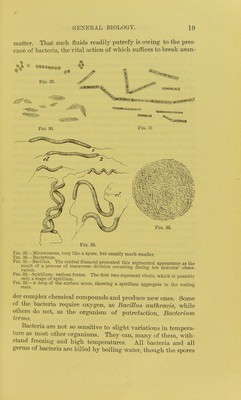
![matter. That such fluids readily putrefy is owing to the pres- ence of bacteria, the vital action of which suffices to break asun- Fig. 29. Fig. 30. Fig. 31. Fig. 33. Fig. 33. Fig. 29.—Micrococcus, very like a spore, but usnally mucli smaller Fig. 30.—Bacterium. Fig. 31.—Bacillus. The central filament presented this segmented appearance as the result of a process of transverse division occurring during ten minutes' obser- Fig. 32.-Spiril]um; various forms. The first two represent vibrio, which is possibly only a stage of spirillum. ^ Fig. 33.—a drop of the surface scum, showing a spirillum aggregate in the resting der complex chemical compounds and produce new ones. Some of the bacteria require oxygen, as Bacillus anthracis, while others do not, as the organism of putrefaction, Bacterium termo. Bacteria are not so sensitive to slight variations in tempera- ture as most other organisms. They can, many of them, with- stand freezing and high temperatures. All bacteria and all germs of bacteria are killed by boiling water, though the spores](https://iiif.wellcomecollection.org/image/b21981450_0043.jp2/full/800%2C/0/default.jpg)