Reactions : a selection of organic chemical preparations important to pharmacy in regard to their behavior to commonly used reagents / by F.A. Flückiger ; translated, rev. and enl. by J.B. Nagelvoort.
- Friedrich August Flückiger
- Date:
- 1893
Licence: Public Domain Mark
Credit: Reactions : a selection of organic chemical preparations important to pharmacy in regard to their behavior to commonly used reagents / by F.A. Flückiger ; translated, rev. and enl. by J.B. Nagelvoort. Source: Wellcome Collection.
178/192 page 150
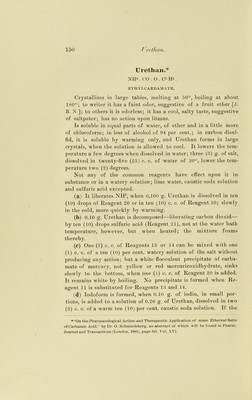
![Urethan.* NH2. CO . O . C2 Hs. ETHYLCARBAMATE. Crystallizes in large tables, melting at 50°, boiling at about 180°; to writer it bas a faint odor, suggestive of a fruit ether [J- B. N.]; to others it is odorless; it bas a cool, salty taste, suggestive of saltpeter; bas no action upon litmus. Is so'luble in equal parts of water, of ether and in a little more of Chloroform; in less of alcohol of 94 per Cent.; in carbon disul- fid, it is soluble by warming only, and Urethan forms in large crystals, wben the solution is allowed to cool. It lowers tbe tem- perature a fevv degrees wben dissolved in water; three (3) g. of salt, dissolved in twenty-five (25) c. c. of water of 20°, lower tbe tem- perature two (2) degrees. Not any of the common reagents have effect upon it in substance or in a watery solution; lime water, caustic soda solution and sulfuric acid excepted. (a) It liberates NH3, when 0,100 g. Urethan is dissolved in ten (10) drops of Reagent 20 or in ten (10) c. c. of Reagent 10; slowly in tbe cold, more quickly by warming. (b) 0.10 g. Urethan is decomposed—liberating carbon dioxid— by ten (10) drops sulfuric acid (Reagent 21), not at tbe water batb temperature, however, but wben heated; the mixture foams thereby. (c) One (1) c. c. of Reagents 13 or 14 can be mixed witb one (1) c. c. of a ten (10) per cent. watery solution of tbe salt without producing any action; but a white flocculent precipitate of carba- mate of mercury, not yellow or red mercuricoxidbydrate, sinks slowly to tbe bottom, wben one (1) c. c. of Reagent 20 is added. It remains white by boiling. No precipitate is formed wben Re- agent 11 is substituted for Reagents 13 and 14. (d) Iodoform is formed, wben 0.10 g. of iodin, in small por- tions, is added to a solution of 0.20 g. of Urethan, dissolved in two (2) c. c. of a warm ten (10) per cent. caustic soda solution. If tbe *“On thePharmacological Action and Therapeutic Application of sonie Ethereal Salts ofCarbamic Acid,” by Dr. O. Schmiedeberg, an abstract of which will be found in Pharm. Journal and Transactions (London, 1885), page 641, Vol, XVI.](https://iiif.wellcomecollection.org/image/b28107007_0178.jp2/full/800%2C/0/default.jpg)