Cemetery burial, or Sepulture, ancient and modern / by George Milner, a director of the Hull General Cemetery Company.
- Milner, George (Director of the Hull General Cemetery Company)
- Date:
- 1847
Licence: Public Domain Mark
Credit: Cemetery burial, or Sepulture, ancient and modern / by George Milner, a director of the Hull General Cemetery Company. Source: Wellcome Collection.
Provider: This material has been provided by The University of Glasgow Library. The original may be consulted at The University of Glasgow Library.
21/40
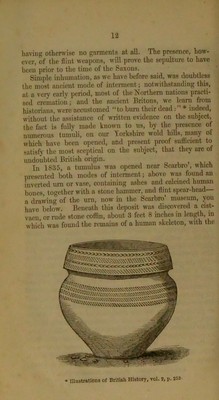
![! commonly called Giuinches. In Tencriffe, the principjd * island, many sj>ecimeus have l)c<‘n discoverer!, showinj; that a similar [)rarnice of erabalminff to that of the Egyptians, ‘ must at one period have Ixm adopted by them. In the highland.s of Peru, animal substances b«;come com- pletely dried up, by mere exjwsure to the air. Human Wdies are there found wTapped uj) in skins of the Viciigmi, ' or Peruvian Camel, bounti closely around by lignturt*3. • ; Many other singular customs, with n'ferenee to burial, might b(? enumerated, were we to traverse the face of the globe; but the reader will doubtless consider enough has beeti aai<l ! on this head. From w hat has Iteen pn^iously advancetl, it wmdd appear that the most ancient method of intenneiit was simple in- humation, or depositing of the body in an entire state, ; beneath the surface of the groiuid; and this w as rloubtless , the prevailing eu.stom amongst the aborigines of ancient ■ Britain : an example of which we are snp]wscd to have in ^ a tum\du8 ojx-ned at Gristhorp, near Si^arbro’, in 1S34, which jiresented a rude coffin, scooped out of the trunk of ■ an oak, in whi<-h was discov(ra*d a human skeleton, with part of the skin of some wild auinud; a .spcar-hcad much oxydixed, some Hint weapons, and a wooden skewer or pin, . near the breast, supjmsed to have l>een used to secure the } skin in which the iK>dy had Ixx u enveloped. These ndics i of by-gone days, are now deposited in the Searbro’ Miucum ; and a descriptive pamphlet wa.s published at the time by ^ Mr. AViiliamson, the curator. Here, it is beUeved, we have : ' an instance of an ancient British interment: the absence of all pottery, seems to indicate a priority over um-burial, and the pres<*nce of the skin seems to correspond with the dress or garments worn by the aborigines of this soil. Cmsar says, “the grcjjter part within the country go clad in skins.” Their mantles were fastened ujron the breast with a thorn, or pointed piece of wood. This fashion might also refer to the Saxons, as Tiioitus informs us, the poon-r sort “wore : jrelts made of beast skins,” f which were fastened w ith a ; chisp, or for want of this, were securetl with a thorn; > • PetU^rew’i HUtnry of KrrpUus Mammies, p. 339. t Speed's Britain, p, 2*9. c 2](https://iiif.wellcomecollection.org/image/b24932309_0021.jp2/full/800%2C/0/default.jpg)