Cemetery burial, or Sepulture, ancient and modern / by George Milner, a director of the Hull General Cemetery Company.
- Milner, George (Director of the Hull General Cemetery Company)
- Date:
- 1847
Licence: Public Domain Mark
Credit: Cemetery burial, or Sepulture, ancient and modern / by George Milner, a director of the Hull General Cemetery Company. Source: Wellcome Collection.
Provider: This material has been provided by The University of Glasgow Library. The original may be consulted at The University of Glasgow Library.
23/40
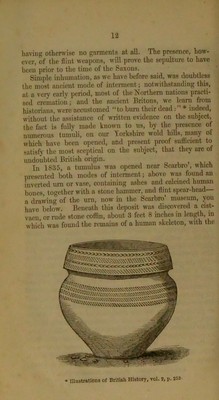
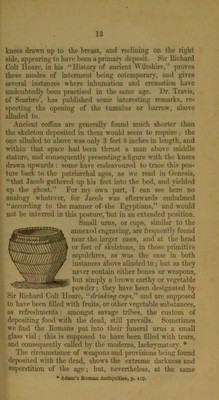
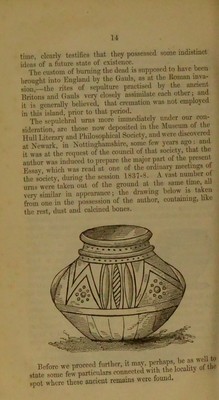
![knees drawTi up to the breast, and reclining on the right side, appearing to have been a primarv- deposit. Sir llichard Colt lloare, in his “History of ancient IViltshire,” proves these modes of interment b«ing eotemporarv', and gives several instances where, inhumation and cremation have undoubtedly l)een practised in the same age. Dr. Travis, of Scarbro’, lias ]mblished some interesting remarks, re- specting the opening of the tumulus or barrow, above alluded to. Ancient coffins are generally foimd ranch shorter than the skeleton deposited in them would seem to require; the one alluded to almve was only 3 feet 8 inches in length, and within that 8])aee had l>cen thnist a man alwve middle stature, and consequently presenting a figure with the knees drawn upwards ; some have endeavoured to trace this pos- ture back to the patriarchal ages, as we read in (Jenesis, “tluit Jacob gathered up Ids feet into the bed, and vicldcHl up the ghost.” For my own part, I can see here no analog}' whatever, for Jacob was afterwards embalmed “aceonling to the manner of the ngviitians,” and would not be interred in this posture, but in au extended position. Small urns, or cups, similar to the annexed engraving, are fre<{ucntly found near the larger ones, and at the head or feet of skeletons, in those primitive sepidchres, as was the ca.se in both instances almve alluded to; but as they never contain either bones or weapons, but simply a brown earthy or vegetable powder; they have been designated by Sir Richiuxl Colt lloare, drinking cvp», and are supposed to have lK;cn filled with fruits, or other vegetable substances, as refreshments: amongst savage tribes, the custom of depositing food with the dead, still prevails. Sometimes we find the Romans put into their funeral urns a small glass vial; this is supposed to have been filled with tears, and consccjuently called by the modmis, lachiymatory. • The circumstance of weapons and jirov'isions bring found deposited with the dead, shows the extreme darkness and superstition of the age; but, nevertheless, at the same * Adam'i Roman AntiqaltiM, p. 418.](https://iiif.wellcomecollection.org/image/b24932309_0023.jp2/full/800%2C/0/default.jpg)