A text-book of physical chemistry / by R.A. Lehfeldt.
- Robert Alfred Lehfeldt
- Date:
- [pref. 1899]
Licence: Public Domain Mark
Credit: A text-book of physical chemistry / by R.A. Lehfeldt. Source: Wellcome Collection.
Provider: This material has been provided by University of Bristol Library. The original may be consulted at University of Bristol Library.
316/330 (page 300)
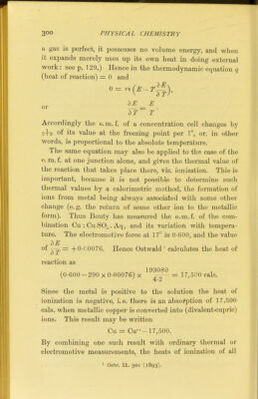
![ii gas is perfect, it possesses no volume energy, and when it expands merely uses up its own heat in doing external work: see p. 129.) Hence in the thermodynamic equation q (heat of reaction) = 0 and T Accordingly the e.m. f. of a concentration cell changes by of its value at the freezing point per 1°, or. in other words, is proportional to the absolute tem][)erature. The same equation may also be applied to the case of the e. m. f. at one junction alone, and gives the thermal value of the reaction that takes place there, viz. ionization. This is important, because it is not possible to determine such thermal values by a calorimetric method, the formation of ions from metal being always associated with some other change (e.g. the return of some other ion to the metallic form). Thus Bouty has measured th6 e.m.f. of the com- bination Cu:CuSO^.Aq, and its variation with tempera- ture. The electromotive force at 17° is 0-600, and the value oi +0-C0076. Hence Ostwald ' calculates the heat of reaction as 193080 (0-600-290 X 0-00076) X 4 9 = 17,500 cals. Since the metal is positive to the solution the heat of ionization is negative, i.e. there is an absorption of 17,500 cals. when metallic copper is converted into (divalent-cupric) ions. This result may be written Cu = Cu---17,500. By combining one such result with ordinary thermal or electromotive measurements, the heats of ionization of all 1 Ostw. 11. 501 (1893).](https://iiif.wellcomecollection.org/image/b21443646_0316.jp2/full/800%2C/0/default.jpg)