A text-book of physical chemistry / by R.A. Lehfeldt.
- Robert Alfred Lehfeldt
- Date:
- [pref. 1899]
Licence: Public Domain Mark
Credit: A text-book of physical chemistry / by R.A. Lehfeldt. Source: Wellcome Collection.
Provider: This material has been provided by University of Bristol Library. The original may be consulted at University of Bristol Library.
86/330 page 70
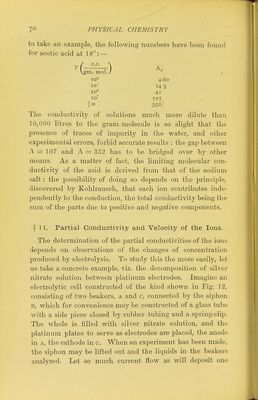
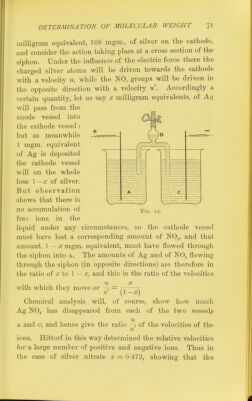
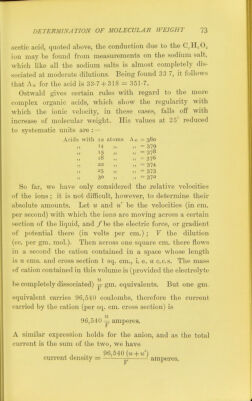
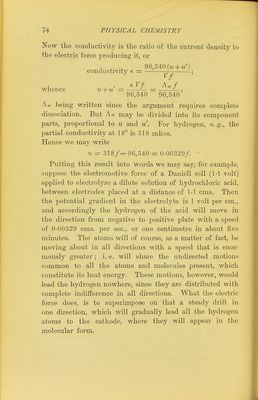
![to take an example, the following numbers have been found for acetic acid at 18° : — The conductivity of solutions much more dilute than 10,000 htres to the gram-molecule is so slight that the presence of traces of impurity in the water, and other experimental errors, forbid accurate results : the gap between A =r 107 and A = 352 has to be bridged over by other means. As a matter of fact, the hmiting molecular con- ductivity of the acid is derived from that of the sodium salt: the possibility of doing so depends on the principle, discovered by Kohlrausch, that each ion contributes inde- pendently to the conduction, the total conductivity being the sum of the parts due to positive and negative components. § 14. Partial Conductivity and Velocity of the Ions. The determination of the partial conductivities of the ions depends on observations of the changes of concentration pi'oduced by electrolysis. To study this the more easily, let us take a concrete example, viz. the decomposition of silver nitrate solution between platinum electrodes. Imagine an electrolytic cell constructed of the kind shown in Fig. 12, consisting of two beakers, a and c, connected by the siphon B, which for convenience may be constructed of a glass tube with a side piece closed by rubber tubing and a spring-clip. The whole is filled with silver nitrate solution, and the platinum plates to serve as electrodes are placed, the anode in A, the cathode in c. Wlien an experiment has been made, the siphon may be lifted out and the liquids in the beakers analyzed. Let so much current flow as will deposit one lo 14 3 41 107 352] 4.60](https://iiif.wellcomecollection.org/image/b21443646_0086.jp2/full/800%2C/0/default.jpg)
 No text description is available for this image
 No text description is available for this image
 No text description is available for this image