A text-book of physical chemistry / by R.A. Lehfeldt.
- Robert Alfred Lehfeldt
- Date:
- [pref. 1899]
Licence: Public Domain Mark
Credit: A text-book of physical chemistry / by R.A. Lehfeldt. Source: Wellcome Collection.
Provider: This material has been provided by University of Bristol Library. The original may be consulted at University of Bristol Library.
96/330 page 80
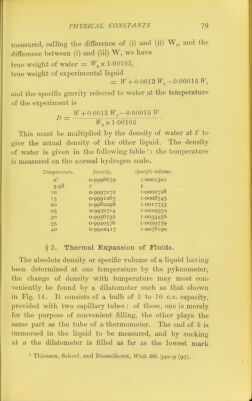
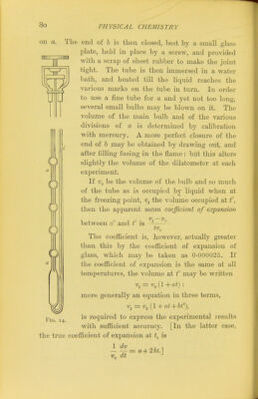
![D 0 on a. The end of h is then closed, best by a small glass plate, held in place by a screw, and provided with a scrap of sheet rubber to make the joint tight. The tube is then immersed in a water bath, and heated till the liquid reaches the various marks on the tube in turn. In order to use a fine tube for a and yet not too long, several small bulbs may be blown on it. The volume of the main bulb and of the various divisions of a is determined by calibration w^ith mercury. A more perfect closure of the end of h may be obtained by drawing out, and after filling fusing in the flame : but this alters slightly the volume of the dilatometer at each experiment. If Vf^ be the volume of the bulb and so much of the tube as is occupied by liquid when at the freezing point, v^ the volume occupied at then the aj)parent mean coefficient of expansion i ¥ ¥ (( Fig. 14. between 0 and f is The coefficient is, however, actually greater than this by the coefficient of expansion of glass, which may be taken as 0-000025. If the coefficient of expansion is the same at all temperatures, the volume at f may be written more generally an equation in three terms, is required to express the experimental results with sufficient accuracy. [In the latter case, the true coefficient of expansion at is = a+2bt.] Vq dt](https://iiif.wellcomecollection.org/image/b21443646_0096.jp2/full/800%2C/0/default.jpg)
 No text description is available for this image
 No text description is available for this image
 No text description is available for this image