Surgery : its theory and practice / by William Johnson Walsham.
- William Walsham
- Date:
- 1889
Licence: Public Domain Mark
Credit: Surgery : its theory and practice / by William Johnson Walsham. Source: Wellcome Collection.
129/864 page 113
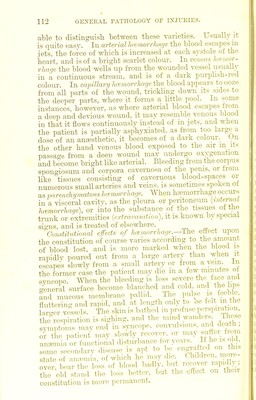
![Constiiutional treatment of hamorrhage.—When the bleeding' has been severe, immediate ate-p^ must be taken to prevent fatal sj^ncope; and after this danger has been tided over, we must then seek to counteract the remote eifects produced upon the whole sj^stem by the loss of blood. 1. Immediate treatment.—Our effortsmust first be directed to arrest, or at any rate to temporarily control, the htemorrhage by some'of the local measures to be presently described. Having done this, the chief indica- tion is to prevent fatal syncope by ensming a sufficient supply of blood to the brain to excite the cardiac centre m the medulla oblongata. Thus, the patient should be laid on his back with his head low, his body warmly covered up, and hot bottles placed at his feet ] or, if the pulse does not improve, stimulants in small quantities should be administered, by the mouth if he can swallow, otherwise by the rectum or by subcutaneous injection ; whilst in severe cases the legs and arms should be held up, or an Esmarch's bandage applied to them in order the better to drive the blood to the brain. As a last resource, transfusion of blood should be practised. Where the bleeding is internal or cannot be arrested, stimulants should be avoided, inasmuch as the syncope into wliich the patient has fallen tends temporarilv to stop the bleed- mg by inducing clotting of the blood in the wounded vessels. If the heart be again roused to action by stimu- lants and the vessels in consequence become dilated, the clots may be displaced, the bleeding re-started, and the last flickering spark of life put out. 2. To courderart tl, remote effects of the loss of blood, fluid nourishment should bo given in small quantities, and then eggs, fish and finally nieat. Ii-on is required to restore' the loss of hfematin, and a sea-voyage or prolonged residence in the country is beneficial in overcoming the anremia. Transfusion of blood maybe required in casus where ueatli is threatened from (;xcessivo hteniorrhago. If blood cannot be readily obtained, milk or a saline solution may be substituted for it. The blood, if possible, should be taken from a healthy adult, and should be transfused by .'Vveling's (Fig. 24) or Eoussol's apparatus directly from the arm of the giver to tlie arm of the ])atieiit; or, if no .special apparatus is at hand, the blood should 'be drawn into a clean vess(d, kept at a tcmperatm-e of from to 100', and injected into the vein by an aspirator or other suitable syringe, (jreat care must be taken to see](https://iiif.wellcomecollection.org/image/b20417925_0129.jp2/full/800%2C/0/default.jpg)



 No text description is available for this image
 No text description is available for this image
 No text description is available for this image