Surgery : its theory and practice / by William Johnson Walsham.
- William Walsham
- Date:
- 1889
Licence: Public Domain Mark
Credit: Surgery : its theory and practice / by William Johnson Walsham. Source: Wellcome Collection.
94/864 page 78
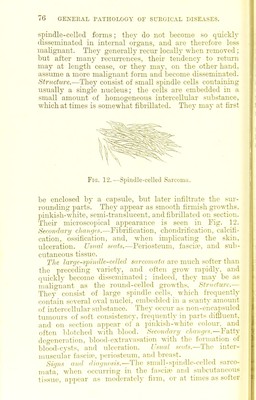
![Secondary changes.—Chondrification sometimes occau's. but ossification is rare. Blood-cysts are very common, fi'om the giving way of some of the numerous tliin-walled vessels. Usual seats.—In the interior of the ends of the long hones, especially the lower end of the femm- and upjier end of the tibia, and in the lower jaw; less rarely they grow from the periosteum. Signs, diagnosis, and treatment.—See Sarcoma of Bone. {d.) The Mixed-celled.—Many sarcomatous tmnom-s consist of both spindle and round cells. They may resemble either the spindle- or the round-celled tumours, and cannot be distinguished ■without a microscopical examination. Sarcomatous hlood-cijsts.—Soft sarcomatous tumoiirs sometimes become comjjletely broken down by exti-avasa- tion of blood into their substance, and converted into cysts containing jjarth^ fluid and partly coagulated blood. When such a cyst is jmnctured, the haemorrhage is often difficult to control. 'WQien cut into, the walls are gene- rally found ill-defined, and it may be impossible to dis- tinguish the cyst from a hamiatoma or ordinary blood- cyst, without a microscopical examination of a jiiece of the wall. II. EPIBLASTIC AXD IIYPOBLASTIC TUMOURS. Tumours of the ti/pe of epithelial tissues [Carcinoma). Carcinojlvt.v, or Caxcers, arc malignant growths consisting of epithelial-like colls contained in an alveolar stroma. The individual cells are not sxuToimded by any intercellular substance as in the sarcomatii, and the vessels run in the stroma, and not among the cells. They arc derived from pre-existing epithelium, and are hence spoken of as tumoiu's of epililastic or hypoldastic origin. The c]ntholiuni is believed to proliferate and break througli tiie Avail of iin acinus or duct, or the basement membrane of the skin or mucous nienibrane. and invade the .surrounding or underlying connective tissue, where it is stip])osed to enter the Ipnjihntic spaces, and thence, sooner or later, ]inss into the lymphatic ycs.«els, and so finally become disseminated. The cells in carcinom.a, though varying in tln'ir chnracter, retain the type of the](https://iiif.wellcomecollection.org/image/b20417925_0094.jp2/full/800%2C/0/default.jpg)



 No text description is available for this image
 No text description is available for this image
 No text description is available for this image