Licence: Attribution-NonCommercial 4.0 International (CC BY-NC 4.0)
Credit: Genetic fix / by Amitai Etzioni. Source: Wellcome Collection.
86/284 page 82
![82 GENETIC FIX contemplate the man of tomorrow who must begin his day by adjusting his spectacles and his hearing aid, inserting his false teeth, taking an allergy injection in one arm and an insulin injection in the other, and topping off his preparations for Ufe by taking a tranquilizing pill, is none too pleasant. To say the least, medical science steadily increases the load it must carry. 2 The session, in which technicalities prohferated, touched on a number of related problems. Was man in fact capable of taking his biological nature into his own hands and safely modifying it? Or was he destined to act out the laws of nature—however cruel or arbi¬ trary—as if nature's will were that of a forbidding and intractable God? And if our intervention had some undesirable eifects, was the only alternative a hands-off return to nature? Or could we correct these side effects without giving up our human thrust? Dr. Arthur G. Steinberg presented the first paper. A tall, distin¬ guished-looking man, he began by saying that the genetic pool was gigantic. The 'gene pool' is the totaUty of the genetic information encoded in the DNA of the species. It includes all the genetic loci (that is, all the genes) and all the alleles [the many functional and nonfunctional forms a gene may take] at each locus in existence within the species at a given time. Steinberg went on to ask, in highly technical terms, how many genetic loci we mean when we say all the genetic loci. He then said; There is no precise answer. An estimate can be made from the amount of DNA in the nucleus of a cell. The human sperm contains about 2.5 X 10'^ grams of DNA. Using 620 as the molecular weight of a nucleotide pair, the number of pairs per human genome [the gene set of a person] is approximately 2 X lOMt is commonly stated that a gene on the average is composed of about a thousand nucleotide pairs—that is, enough to code for shghtly more than three hundred amino acids. If so, the human genome has about two milUon genes. But this is only the beginning of the determination of the size of the human gene pool—it merely measures the number of loci. Each locus may exist in the species in a large number of allehc forms. How many alleles, in theory, may a locus have? The number is enormous. Steinberg explained that the pool was vast: The average muta¬ tion rate per gene per generation is about 10-' or 10-^ Even the conservative estimate of 10' or 10® would supply adequate oppor¬ tunity for the species to accumulate, over time, a large number of](https://iiif.wellcomecollection.org/image/b18035954_0087.JP2/full/800%2C/0/default.jpg)
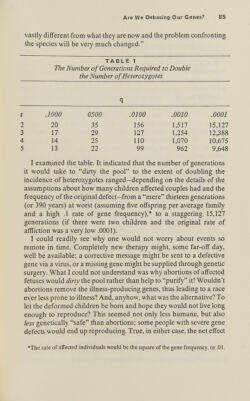
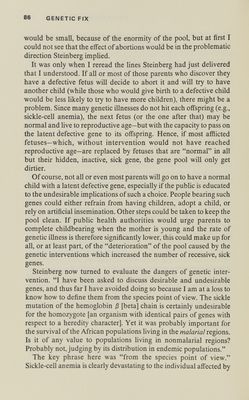
 No text description is available for this image
 No text description is available for this image
 No text description is available for this image