Licence: Attribution-NonCommercial 4.0 International (CC BY-NC 4.0)
Credit: Genetic fix / by Amitai Etzioni. Source: Wellcome Collection.
90/284 page 86
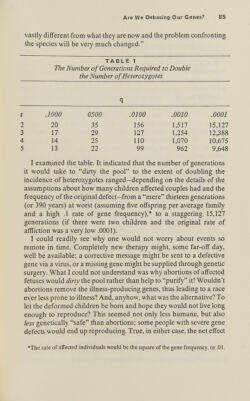
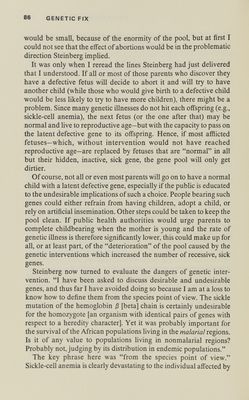
![86 GENETIC FIX would be small, because of the enormity of the pool, but at first I could not see that the effect of abortions would be in the problematic direction Steinberg imphed, it was only when I reread the lines Steinberg had just deUvered that I understood. If aU or most of those parents who discover they have a defective fetus will decide to abort it and will try to have another child (while those who would give birth to a defective child would be less likely to try to have more children), there might be a problem. Since many genetic illnesses do not hit each offspring (e.g., sickle-cell anemia), the next fetus (or the one after that) may be normal and live to reproductive age—but with the capacity to pass on the latent defective gene to its offspring. Hence, if most afflicted fetuses—which, without intervention would not have reached reproductive age—are replaced by fetuses that are normal in all but their hidden, inactive, sick gene, the gene pool will only get dirtier. Of course, not all or even most parents will go on to have a normal child with a latent defective gene, especially if the public is educated to the undesirable imphcations of such a choice. People bearing such genes could either refrain from having children, adopt a child, or rely on artificial insemination. Other steps could be taken to keep the pool clean. If public health authorities would urge parents to complete childbearing when the mother is young and the rate of genetic illness is therefore significantly lower, this could make up for all, or at least part, of the deterioration of the pool caused by the genetic interventions which increased the number of recessive, sick genes. Steinberg now turned to evaluate the dangers of genetic inter¬ vention. I have been asked to discuss desirable and undesirable genes, and thus far I have avoided doing so because I am at a loss to know how to define them from the species point of view. The sickle mutation of the hemoglobin ß [beta] chain is certainly undesirable for the homozygote [an organism with identical pairs of genes with respect to a heredity character]. Yet it was probably important for the survival of the African populations living in the malarial regions. Is it of any value to populations living in nonmalarial regions? Probably not, judging by its distribution in endemic populations. The key phrase here was from the species point of view, Sickle-cell anemia is clearly devastating to the individual affected by](https://iiif.wellcomecollection.org/image/b18035954_0091.JP2/full/800%2C/0/default.jpg)
 No text description is available for this image
 No text description is available for this image
 No text description is available for this image