English cookery five hundred years ago : exhibited in sixty "nyms", or receipts.-From a manuscript, compiled about 1390, by the master cooks of King Richard the Second, entitled "The forme of cury," &c.-Printed (verbatim) / [By Charles Clark ... at his private press] in black letter, with the addition of a running glossary and notes.
- Charles Clark
- Date:
- 1849
Licence: Public Domain Mark
Credit: English cookery five hundred years ago : exhibited in sixty "nyms", or receipts.-From a manuscript, compiled about 1390, by the master cooks of King Richard the Second, entitled "The forme of cury," &c.-Printed (verbatim) / [By Charles Clark ... at his private press] in black letter, with the addition of a running glossary and notes. Source: Wellcome Collection.
Provider: This material has been provided by The University of Glasgow Library. The original may be consulted at The University of Glasgow Library.
11/30
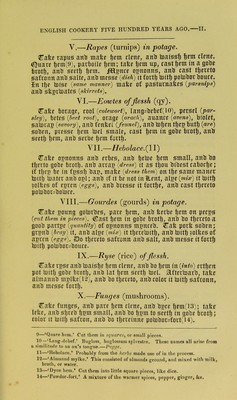
![XVI.—Monchelet (qy). ®:afee beel, other {or) moton, anb finite it to gohettJJ(l9). 5eeti) it in gotie broth- ffiast thereto h^^bfs B h^bie {shred)^ gobe tojone, anb a guantitie of ognoims mgnceb, pob)bor4ort, anb safronn; anb aljie {mix) it biith agrenn anb bergons {ver- juice)] but lat not seeth after. XVII.—Bukkenade (qy). Cafee oih^^ con^nges {rabbits), other beet, othrr {or) other flessh, anb hebie hrm to gobetts; biaische {wash) it, anbf hit b3ell(20). ®rrBnbe almanbes unblancheb, anb brabie h^nt up biith the broth, (ttaste ihereinne ragsons of corance {cur- rants), sugar, pobibor ggnger, erbes gstebieb {stewed) in grees {fat, or lard), opnonns anb salt. 5f it is to {too) thgnne, alge {mix) it ujp bjit'h fioer of rgse {rice), other boith bttjrr thKaff# anb color it biith safronn. XVIII.—Conna#e5(21). ®atte tonnes anb pare h^at; pBlte {pick) out the best, anli bo {put) hem in a pot of ertfje {earthen pot), HBo thereto bihgte greet {lard), that he stebie thereinne, anb Ige {mix) hem up boith honj}(22) clarifieb, anb biith rabie lolfees, anb boith a Igtell al= mannb mplfce, anb bo thereinne potober^ort anb safronn; anb lobe that it be gleesheb {cut into slices), XIX.—Drepee (qy). Cabe blancheb almanbes, gignbe hem, anb temper hrm up biith gobe broth; tabe ognonns, a grete guantite, perbojole hem, anb frge hrm, anb bo^ {put) thereto. Cabe small bj)rbbes {birds), perbople hrni, anb bo thereto pellBbore(23), anb salt, anb a Iptel greet. 19— ‘Smite it to gobetfs.’ Cut it into large pieces, “Better and gretly more plesaunt is a morsell, or litle ffobet of brede with joye,” &c. Vide Jun. Etym. in Verb. 20— ‘Hit well.’ Probably, bray it well. 21— ‘Connates.’ This dish seems to have been a kind of marmalade of connes, or quinces, from the French coing,—Pegge. 22— ‘Ilony clarified.’ From the most remote antiquity, and in the unrefined pe- riods of almost all nations, we find honey to have been used, either as a dish of it- self, or an ingredient in others. This would be the case, of course, in those coun- tries, where the industry of the bee supplied, without trouble, this agreeable arti- cle. Its use continued to be general till the introduction of sugar allbrdcd a sweetener more agreeable to the palate. We meet with it frequently in the Bible, as a luxury well known at the patriarchal table. The Greeks also were fond of honey in their dishes, Schol. Aristoph. ad Equit. v. 1100. And the Roman cook was continually making use of it. Vide Apicium. The Danes were very partial to It also, and their favourite beverage, the metheglin, was composed chiefly of it. Mallet’s North. Ant. The English possessed the same predilection for it, a predi- lection which, on a particular occasion, proved fatal to a great many of them. For we are told, that the soldiers of Edward 1. in marching through Palestine, ate so freely of honey, that vast numbers of them died in consequence of it. 23—‘Pellydore.’ Perhaps pellitory.—Pegge,](https://iiif.wellcomecollection.org/image/b24921543_0013.jp2/full/800%2C/0/default.jpg)