Miscellaneous works of the late Thomas Young, M.D., F.R.S., &c., and one of the eight foreign Associates of the National Institute of France.
- Thomas Young
- Date:
- 1855
Licence: Public Domain Mark
Credit: Miscellaneous works of the late Thomas Young, M.D., F.R.S., &c., and one of the eight foreign Associates of the National Institute of France. Source: Wellcome Collection.
62/653
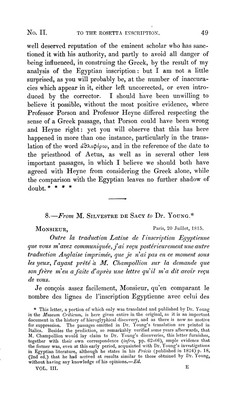
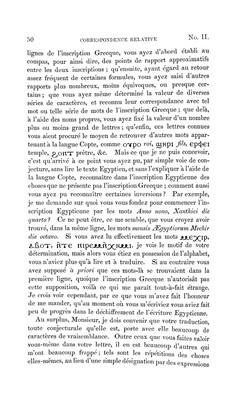
![found, nearly in the same form, in the 13th and 15th lines : it seems to be related to 6xS and x^.xi- 5. I cannot agree with you respecting the insertion of the date of the year in the fourth line of the inscription ; and of the seven forms in which you suppose the word to appear, in dif- ferent lines, I can only admit the first and the last as correct, The characters in the fourth line occur, with very little vari- ation, in lines 25, 28, and 29 [as above, n. 44], in the sense of day: and since they are not found in the next line, where the Greek has ttj ■hy^sqiji. raurrt, I think myself fully authorised to consider them as corresponding to that expression, which may be introduced in this place with perfect propriety; the second part of the group occurs in the last line, apparently in the sense of this, but the Greek inscription is here defective. 6. With respect to your illustrations of the inscription fi-om the more modern Coptic, I shall only observe in general, that as you have seldom expressed any great degree of confidence in your own conjectures, you cannot be surprised if I have still less disposition to be satisfied with them. The nature of my objections, in many particular instances, will occur to you from the inspection of the readings which I have attempted in my letter to Mr. de Sacy : among these, however, you will observe several words which have also occurred to yourself; and such a coincidence, as far as it extends, cannot but be satisfactory to us both: but I apprehend that if you had simply made a com- plete alphabetical enumeration of all the forms, which you have been obliged to attribute to the respective letters, even in the first five lines, you would yourself have been alarmed at the inextricable confusion of heterogeneous elements which you have, perhaps unavoidably, introduced. 7. There is a word [n. 31] signifying men or persons in the 1st and 9th lines : it is formed of a single character, which you read pe, not without some probability, although in other passages I have thought the character better expressed by f or et ■ it is preceded by a letter which is one of the many forms that you attribute to it, or t, or ^ , or j, while I have thought it safer to make it an aspirate only ; and it is followed by a single vertical stroke, or an e- This is the common, and](https://iiif.wellcomecollection.org/image/b2118270x_0062.jp2/full/800%2C/0/default.jpg)
 No text description is available for this image
 No text description is available for this image
 No text description is available for this image