Miscellaneous works of the late Thomas Young, M.D., F.R.S., &c., and one of the eight foreign Associates of the National Institute of France.
- Thomas Young
- Date:
- 1855
Licence: Public Domain Mark
Credit: Miscellaneous works of the late Thomas Young, M.D., F.R.S., &c., and one of the eight foreign Associates of the National Institute of France. Source: Wellcome Collection.
63/653
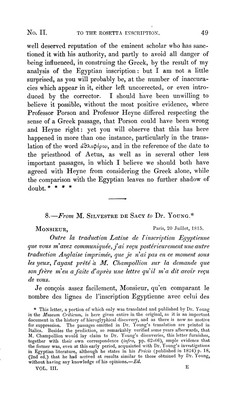
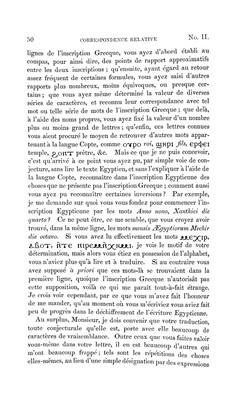
![I think the only way of forming a plural in the inscription: the shape of the prefix varies a little ; but it has always a correspond- ing dash at the end of the word or words which it renders plural, except in the word gods, where the prefix is repeated instead of the dash. I cannot therefore agree with you in making this group a part of the word peeJUt or peJUL) although your opinion of the admissibility of such a word in a separate form, for pajjULIj is strengthened by the authority of Woide's Appendix, Apoc. iii. 7, where we have, in the Thebaic dialect, e pJjL nTKpq- 8. You will observe that I have not inserted the word pjOlVT among my readings, and I have no inclination to de- fend it; but you must also allow me to consider your reading OTkB- as absolutely arbitrary. Petephre, who was a pagan priest, is called p,ortTr in Gen. xli. 45. 9. I agree with you that the word victory is included in the term prize-bearer ; but I am sorry to deprive you altogether of Mr. Palin's authority, for he most assuredly never saw the part of the hieroglyphic inscription corresponding to this passage. 10. I do not know that it is possible to be quite certain whe- ther the Greek or the Egjrptian was the original of the decree, and I allow that there is much truth in your remark, that it seems improbable that the Egyptians should have wanted a single term to express the tiremen of the gods. But it is quite certain that the Greeks had such a term, and you have yourself mentioned it. Why, therefore, was it not employed, if the Greek was the original ? I cannot agree with you in thinking that either ela-TropEvoixevoi here, or dwavrytaavrts in the subsequent part of the line, is omitted in the Egyptian; on the contrary, the same characters occur in both these passages, and for KarsXbovras in line 11, as well as in many other places, with very little variation. 11. The oT of your oTf^e, itoT^, nep4>HO')fe, oTCJong,, andjuLepiOTj I apprehend, is supported by no authority what- ever: the character occurs in the word temple, but in the singular as well as in the plural [n. 80], and there can be no oif in the singular. The same character is certainly found at the end of the name of the month juLecujpH: and I have](https://iiif.wellcomecollection.org/image/b2118270x_0063.jp2/full/800%2C/0/default.jpg)
 No text description is available for this image
 No text description is available for this image
 No text description is available for this image