Principles and practice of crowning teeth : a practical, systematic and modern treatise upon the requirements and technique of artificial crown work, including some incidental reference to bridgework. With 459 illustrations / By Hart J. Goslee.
- Goslee, Hart J., 1871-1930.
- Date:
- 1903
Licence: Public Domain Mark
Credit: Principles and practice of crowning teeth : a practical, systematic and modern treatise upon the requirements and technique of artificial crown work, including some incidental reference to bridgework. With 459 illustrations / By Hart J. Goslee. Source: Wellcome Collection.
Provider: This material has been provided by the Augustus C. Long Health Sciences Library at Columbia University and Columbia University Libraries/Information Services, through the Medical Heritage Library. The original may be consulted at the the Augustus C. Long Health Sciences Library at Columbia University and Columbia University.
52/312 (page 40)
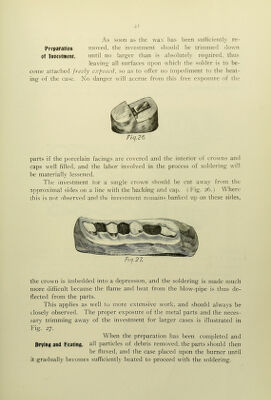
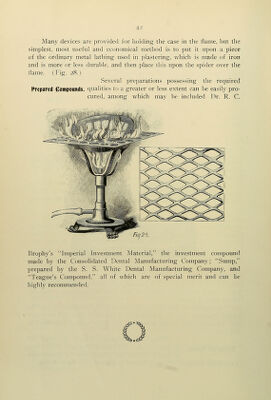
![parts firmly to first remove the model from the articulator, and then trim away all surplus plaster until only enough remains to sustain the relation. (Fig. 25.) This, then, precludes the possibility of any disarrangement or displacement of the parts, and the remaining plaster is of no signifi- cance if entirely submerged and completely covered with the invest- ment material. The investmicnt compound should be mixed of Pf(C3UtiOn$. a moderately thin and plastic consistency, so that when the proper quantity is poured upon a piece of paper it will offer no resistance in pressing the case down into place, until it is properly submerged and sufficiently covered. If too stiff there would be danger of a change in the relation of the parts. To make sure of a close adaptation of the material to the facings and other parts, and to hold them securely when invested, all surplus wax and dirt should be carefully removed and the case dipped in water just previous to bringing it in contact with the investment material. Fic].25. The interior of all crowns and caps unless previously well -filled with plaster should then be first thoroughly packed with the investment ma- terial by using a small piece of wood or fine-pointed spatula; because if not perfectly filled the presence of air spaces, into which the heat be- comes concentrated during the process of soldering, will materially in- crease the liability of burning or fusing the parts, an accident which for this reason not infrequently occurs. After the investment has become thoroughly K^tnovind Ultax. hardened and the surplus trimmed away, the -wax should be slightly warmed by passing over the flame and removed as well as possible with a small knife-blade or other pointed instrument, being careful not to loosen or dislodge the parts in so doing. Hot water may be then poured upon it, but the case should never be boiled, for the reason that such procedure disintegrates the com- pound, interferes with its perfect crystallization, and requires more time in drying out and heating up than would otherwise be necessary. Choloroform, being a solvent of wax, is also used to remove remain- ing particles, but this is-entirely unnecessary, because the wax will be ab- sorbed by the investment and ultimately burned out entirely during the heating process.](https://iiif.wellcomecollection.org/image/b21220955_0052.jp2/full/800%2C/0/default.jpg)