Mental differences in certain immigrant groups : psychological tests of south Europeans in typical California schools with bearing on the educational policy and on the problems of racial contacts in this country / by Kimball Young.
- Kimball Young
- Date:
- [1922]
Licence: Attribution-NonCommercial 4.0 International (CC BY-NC 4.0)
Credit: Mental differences in certain immigrant groups : psychological tests of south Europeans in typical California schools with bearing on the educational policy and on the problems of racial contacts in this country / by Kimball Young. Source: Wellcome Collection.
12/106 page 10
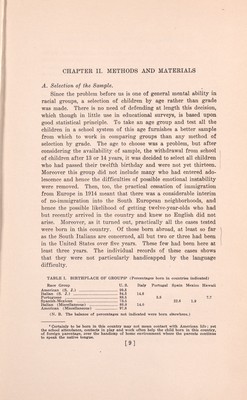
![The communities studied were: San Jose, Santa Clara, South San Francisco, Sunnyvale, Half Moon and Milpitas. All these cities and towns had a relatively high percentage of population of South European ancestry, while the bulk of the remaining population was of older standing in the communities and of Northern European background: English, German, Scandinavian almost completely. The following percentages of population of this latter background compared with that of the various South European are typical: For San Jose, Northern European ances try (“Americans”), 56.5 per cent; South Italian, 35.3 per cent; Portuguese, 2.1 per cent and Spanish-Mexican, 5.9. Correspond ing figures for Santa Clara are: 37.4; 5.8; 39.0; 20.7. For South San Francisco: 27.0; 57.1; 14.2; 1.0. B. Selection of Psychological Tests. Since it was the purpose in this study to handle rather large numbers of cases, and to select tests which would answer the question of alleged language handicap, the Binet test was out of the question. We chose two group tests, one decidedly verbal in its make-up, the other purely performance and not dependent on knowledge of English for its successful manipulation. The first, the army alpha, differentiates mentality down to ten years mental age or slightly lower perhaps. It would outreach the mentality of any superior child found in the group. The correlation of -|- .99 of alpha with Binet in the army testing proves the satis factoriness of the test for diagnosis of groups (73, p. 99). The other test, beta, was the best performance test available. The procedure was modified slightly over that given in the army to permit instructions to be given in simple language rather than by pantomime as was done in the former case. The method of pre senting typical forms and demonstrating was continued. Then came simple verbal expression, for example: “Look at your papers, Test Six. Draw in the missing parts as I did on the board.” C. Outside Criteria. To check the statistical results from the tests, data on grade location, teachers’ estimates of school work and of intelligence were collected. Also the occupations of the parents, for a possible cue to the influence of economic level on the standing in the tests. The scale for making these various estimates will be noted when the results of the data are presented. [ 10 ]](https://iiif.wellcomecollection.org/image/b18026205_0013.JP2/full/800%2C/0/default.jpg)