Mental differences in certain immigrant groups : psychological tests of south Europeans in typical California schools with bearing on the educational policy and on the problems of racial contacts in this country / by Kimball Young.
- Kimball Young
- Date:
- [1922]
Licence: Attribution-NonCommercial 4.0 International (CC BY-NC 4.0)
Credit: Mental differences in certain immigrant groups : psychological tests of south Europeans in typical California schools with bearing on the educational policy and on the problems of racial contacts in this country / by Kimball Young. Source: Wellcome Collection.
19/106 page 17
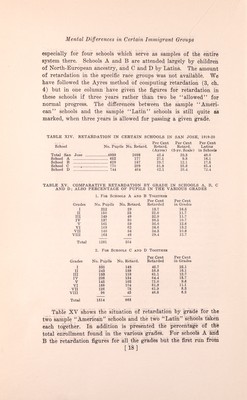
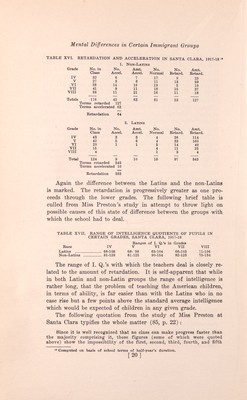
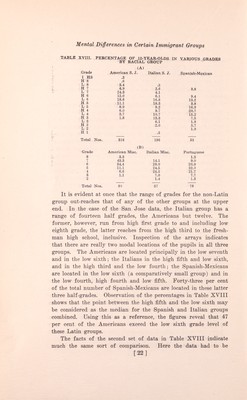
![the Spanish-Mexican groups are transient on the whole compared to the South Italian. The effects on the school are noticeable in three particulars: (1) school discipline, (2) teaching problem, (3) retardation. All three are closely related to the one outstanding feature: the dif ference in educability of the child of foreign parentage and the child of North European ancestry. In discipline the problem was one of dealing with temperamental differences in the groups, and in enforcing school attendance. The parents of the Italian, Por tuguese and Spanish-Mexican children little realized the American mores on the place of education in our life. Their interests being immediately economical, the attendance laws had to be vigorously enforced. In the case of San Jose and Santa Clara, the last five years, at least, has seen a very determined and successful attempt to bring the child of foreign parentage into the school and to keep him there. The long tenure of certain well-qualified principals and teachers has assisted in this matter. The teaching problem became really one of dealing with children of different cultural backgrounds, and in the first few years many of them had diffi culty acquiring the use of the English which is the key instrument to the acquisition of the elementary curricula. No attempt was made beyond observational method to rate the teaching efficiency of the school systems studied. So far as San Jose, Santa Clara, Sunnyvale and South San Francisco are concerned the teaching there was average considering the somewhat crowded conditions in the class-rooms and a somewhat ancient rule of pedagogical pro cedure. The principals in the schools attended by the foreign children were all exceptionally alive to their problem, and re arrangements of sections, rooms for retarded and backward, and such usual makeshifts were in use. In the case of the schools in more rural districts, like Half Moon and Milpitas, the handicaps of the ordinary country school were more apparent; several grades to a teacher, lack of equipment and poor compensation. But even in these eases the work was pretty high calibre, for these com munities are in well-regulated parts of state whose entire school system is in the first rank of our country. Facts of retardation furnish the most convenient presentation of the educational situation. Certain sample facts were collected on age-grade distributions in San Jose and Santa Clara which throw into relief at once the crux of our problem. The following tables summarize the matter for the entire city of San Jose and [17]](https://iiif.wellcomecollection.org/image/b18026205_0020.JP2/full/800%2C/0/default.jpg)

 No text description is available for this image
 No text description is available for this image
 No text description is available for this image