Mental differences in certain immigrant groups : psychological tests of south Europeans in typical California schools with bearing on the educational policy and on the problems of racial contacts in this country / by Kimball Young.
- Kimball Young
- Date:
- [1922]
Licence: Attribution-NonCommercial 4.0 International (CC BY-NC 4.0)
Credit: Mental differences in certain immigrant groups : psychological tests of south Europeans in typical California schools with bearing on the educational policy and on the problems of racial contacts in this country / by Kimball Young. Source: Wellcome Collection.
29/106 page 27
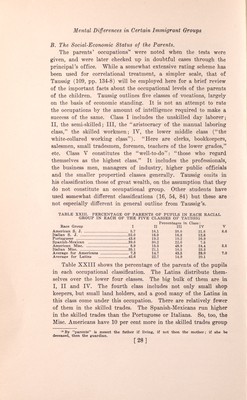
![TABLE XXII. MEAN TEACHERS’ RATING OF SCHOOL WORK FOR EACH GRADE, ALL PUPILS BEING 12-YEAR-OLDS H L H L H L H L H L H L H I Grades 2 3 3 4 4 5 5 6 6 7 7 8 8 HS Amer. S. J. 6.00 4.75 4.71 4.21 4.13 3.68 3.68 3.46 3.27 2.68 * * Italian S. J. 5.25 5.00 5.66 4.88 4.70 4.69 4.00 3.91 4.26 3.75 3.10 Spanish-Mex. 5.34 4.50 4.25 4.87 4.40 4.56 3.25 3 4 5 6 7 Portuguese 5.16 4.67 4.28 4.29 4.67 t * Omitted because of too few cases, t Portuguese in full grades. Table XXII shows this feature of the matter of school work as related to grade and age factors. Tabulating the 12-year-olds for American and Latin groups by their grade location and then determining the mean of the teacher-ratings of school work for those in the particular grades, one is able to see again that the teachers’ estimates are about what one would expect. Not only is the retarded 12-year-old back in his grade location, but he is also retarded in his school ability in the grade in which he is found. The table shows that beginning with the lowest grade in the case of the Italian children, the mean of the average ratings on school work are below the average for that particular grade, but as one goes up the scale toward the grades normally occupied by the 12-year-olds he finds the mean approaching the average for the grade. At the high fifth the Italian seems to be average for his grade, he is slightly better for the low sixth, not so good in high sixth, and again better in the next two half grades. The number of cases is small in high seventh and there is but one case in low eighth. In the case of the Americans much the same thing is observed. The 12-year-old who is in the lower grades is poorer in his class than the much younger but abler pupils even though he has sat in his grade perhaps two or three terms. The Ameri cans rate “average” at about the same point as the Italians (be tween the high fifth and the low sixth grades). But both the Italians and, more so, the American children, who are in the sev enth and eighth grades do better than the average of the class. As the 12-year-olds in the lower grades are much more retarded than the younger children in these grades, so the 12-year-old who is advanced in his grade is also superior to the average of his class. Like figures are given in the table for the Portuguese and Spanish, but the numbers in the separate classes are rather small. The Portuguese, it will be recalled, are tabulated only in whole grades. But, in general, the same situation holds for these pupils. The 12-year-old who is in the lower grades is poorer in school per formance than his class average, although he has had the advan tage of additional time, study and teachers’ instruction. [27]](https://iiif.wellcomecollection.org/image/b18026205_0030.JP2/full/800%2C/0/default.jpg)


 No text description is available for this image
 No text description is available for this image
 No text description is available for this image