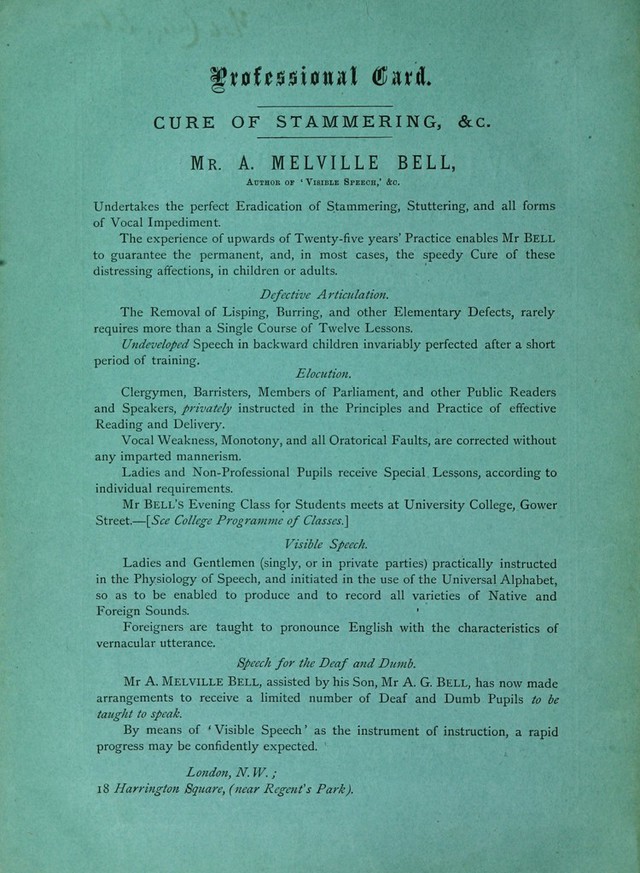
English visible speech for the million : for communicating the exact pronunciation of the language to native or foreign learners, and for teaching children and illiterate adults to read in a few days.
- Alexander Melville Bell
- Date:
- [1868]
Licence: Public Domain Mark
Credit: English visible speech for the million : for communicating the exact pronunciation of the language to native or foreign learners, and for teaching children and illiterate adults to read in a few days. Source: Wellcome Collection.
Provider: This material has been provided by the Harvey Cushing/John Hay Whitney Medical Library at Yale University, through the Medical Heritage Library. The original may be consulted at the Harvey Cushing/John Hay Whitney Medical Library at Yale University.
8/24 page 5
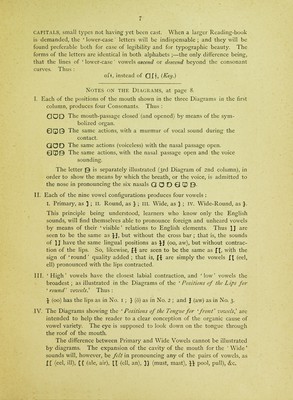
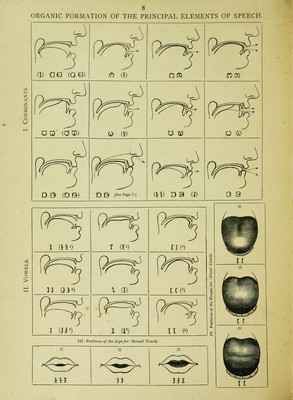
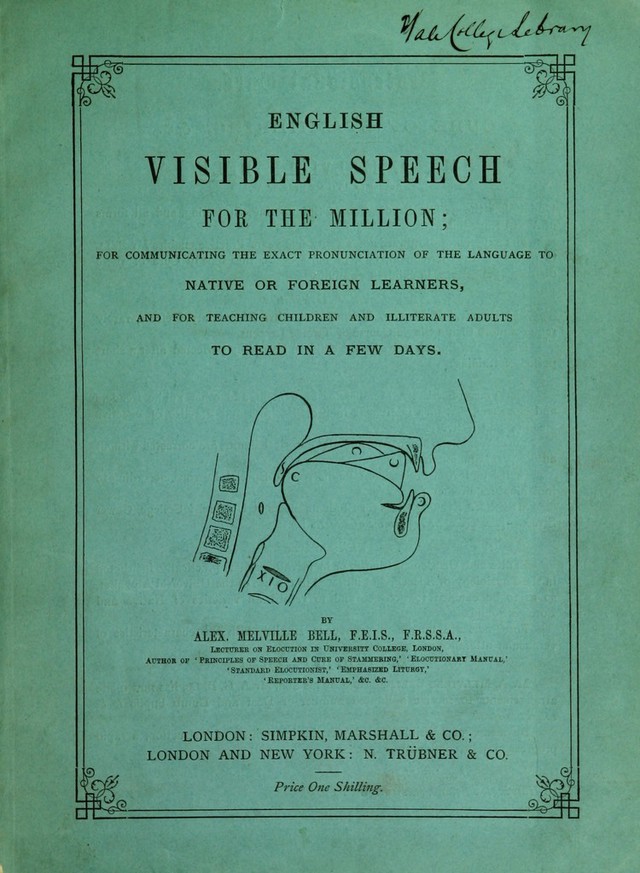
![those of the preceding letters which have a straight line within the organic curve are vocal consonants,—as Q Q t3 6*3 (G D B Z), &c. ; and letters without a central straight line are non-vocal consonants,— as Q D D Q (K T P S), &c. 4. The sign of NASAL quality is j (the line of curvature of the soft palate— the nasal valve*), and therefore the letters which have this sign incorporated are formed by passing the breath or the voice through the nose; as QQ, (NG), OQ (N), DB (M). 5. When the passage of the mouth is completely closed by the symbolized organ, the ends of the organic curve are ' shut' by a connecting line ; as Cia O0, DO (KG 'hard,' TD, PB). 6. When the symbolized part of the mouth divides the passage for the breath or the voice, so as to allow only of lateral emission, the organic curve is indented or 'divided;' as CDCO (L), S2S»D (TH), 33 (FV). EXPLANATION OF VOWEL LETTERS. 7. The sign of VOICE (a straight line) is common to all the vowel letters; a subordinate symbol or 'definer' being added to denote the part of the mouth which modifies the vowel. Thus : ' Back' of the tongue [to left] X 3 3 J as in mention, up, ask, arm. ' Front' of the tongue [to right] f £ [ C I I • • • as in eel, ill, ale, air, ell, an. ' Mixed' (back & front) [to left & right] I X I • • as in places, fatal, sir. 8. When the LIPS are contracted, or drawn across the aperture of the mouth, so that the quality of the vowel is ' rounded,' a symbolic bar is drawn across the vowel line. Thus : ' Back-Round,' } \ J J J J . . . . as in pool, ptdl, old, ore, all, on. ' Mixed-Round,' | i as in pleasure, orator. 9. The ' definer' for vowels stands at the top, the bottom, or at both ends of the straight line, according as the symbolized part of the tongue is ' High' (1III11I), 'Mid' (]]XCC}J),or 'Low'(JIUJJI). 10. The letters with solid points as their ' definers ' (3 It 113 J) are PRIMARY vowels, or those most allied to consonants [see Explanation of ' Glides']; the letters with open hooks are WIDE vowels, or those which have the inner cavities of the mouth and the throat most fully expanded. Otherwise, the pairs of vowels 33 ■ II, [ C 11, &c., have respectively the same positions of the tongue, &c. EXPLANATION OF GLIDES. 11. Primary Consonants and Primary Vowels result from similar configura- tions of the parts of the mouth, but with the difference,—that, for consonants, the passage between the organs is narrow and yielding, so that a fricative sound of hissing or buzzing accompanies the emission of the breath or the voice ; while, for vowels, the passage is expanded and firm, and the voice flows through the free resonant tube without accompanying sibilation. GLIDES are sounds of * See Diagram on Title-page.](https://iiif.wellcomecollection.org/image/b21034254_0008.jp2/full/800%2C/0/default.jpg)