Human physiology : prepared with special reference to students of medicine / by Joseph Howard Raymond.
- Raymond, Joseph H. (Joseph Howard), 1845-1915
- Date:
- 1901
Licence: Public Domain Mark
Credit: Human physiology : prepared with special reference to students of medicine / by Joseph Howard Raymond. Source: Wellcome Collection.
Provider: This material has been provided by the Augustus C. Long Health Sciences Library at Columbia University and Columbia University Libraries/Information Services, through the Medical Heritage Library. The original may be consulted at the the Augustus C. Long Health Sciences Library at Columbia University and Columbia University.
37/712 (page 33)
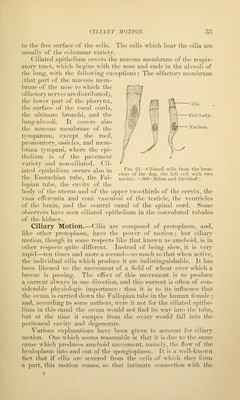
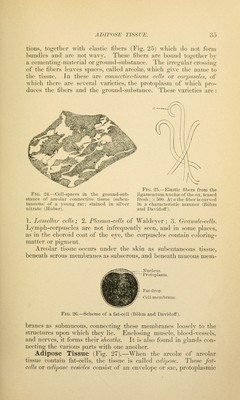
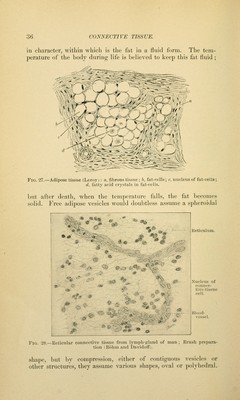
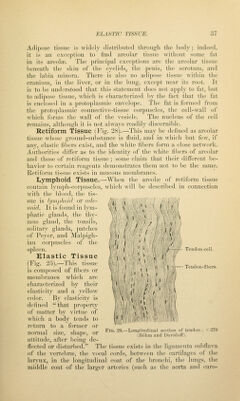
![['ilia. - Nucleus. Fig. 23.—Ciliated cells from the bron- chus of the dog, the left cell with two nuclei; X 600 ( Bohm and Davidott'j. to tlio tVco surfaco of tlu- cells. Tlic cells wiiicli bear the cilia are iisiinlly of the columnar variety. Ciliated e])itheliuni covers the mucous membrane of the respir- atory tract, which bctrins with the nose and ends in the alveoli of the liniir, witli tiie followino; exceptions: The olfactory membrane (that part of the mucous mem- brane of the nose to which the olfactory nerves are distributed), the lower part of the pharynx, the surface of the vocal cords, the idtimate bronchi, and the luntr-alveoli. It covers also tile mucous meml)rane of tiie tympanum, except the roof, promontory, o.ssicles, and mem- brana tympani, where the epi- thelium is of the pavement variety and non-ciliated. Cil- iated epithelium occurs also in the £;ustachian tube, the Fal- lopian tube, the cavity of the body of the uterus and of the upper two-thirds of the cervix, the vasa eiferentia and coni va.sculosi of the testicle, the ventricles of the brain, and the central canal of the spinal cord. Some observers have seen ciliated epithelium in the convoluted tubules of the kidney. Ciliary Motion.—Cilia are composed of protoplasm, and, like other protoplasm, have the power of motion ; but ciliary motion, though in some respects like that known as ameboid, is in other respects quite different. Instead of being slow, it is very rapid—ten times and more a second—so much so that when active, the individual cilia which produce it are indistinguishable. It has been likened to the movement of a field of wheat over which a breeze is passing. The effect of this movement is to produce a current always in one direction, and this current is often of con- siderable physiologic imjxjrtance : thus it is to its influence that the ovum is carried down the Fallopian tube in the human female ; and, according to some authors, were it not for the ciliated epithe- lium in this canal the ovum would not find its way into the tube, l)Ut at the time it escapes from the ovary would fall into the peritoneal cavity and degenerate. Various explanations have been given to account for ciliary motion. One which seems reasonable is that it is due to the same cause which produces ameboid movement, namely, the flow of the hyaloplasm into and out of the spongioplasm. It is a well-known fact that if cilia are severed from the cells of which they form a part, this motion cea.ses, so that intimate connection with the 3](https://iiif.wellcomecollection.org/image/b21209893_0037.jp2/full/800%2C/0/default.jpg)