Human physiology : prepared with special reference to students of medicine / by Joseph Howard Raymond.
- Raymond, Joseph H. (Joseph Howard), 1845-1915
- Date:
- 1901
Licence: Public Domain Mark
Credit: Human physiology : prepared with special reference to students of medicine / by Joseph Howard Raymond. Source: Wellcome Collection.
Provider: This material has been provided by the Augustus C. Long Health Sciences Library at Columbia University and Columbia University Libraries/Information Services, through the Medical Heritage Library. The original may be consulted at the the Augustus C. Long Health Sciences Library at Columbia University and Columbia University.
45/712 (page 41)
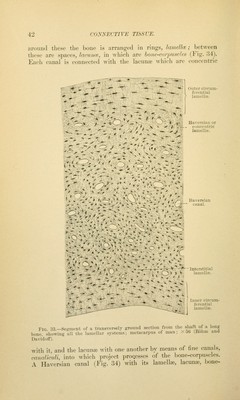
![tlic articular cartilages of some joints, as the knee and the wrist; connecting, as between the bodies of the vertebrae; circumferaitial, as in the cotyloitl cavity of the hip-joint, which it makes deeper ; anil fifnififonn, where it lines i^rooves in bone thronji:!! which tendons ]kiss. It also occurs in some tendons, as in that of tiie peroneus lonu'us. Yellow Elastic Cartilage (Fig. 32).—The presence of elastic libers in tiie niiitrix is the distinguishing feature of tiiis variety of cartilage, which is found in the pinna of the ear, the Eustachian tube, the epiglottis, and the cornicula laryngis. Cellular Cartilage.—This kind is made up almost wholly of cells ; sometimes fine fibers are present. The only structure in which it is found in the human body is the cJiorda dorsa/is or notuchord of the embryo. Chemical Composition of Cartilage.—The following analyses were made by Hoppe-Seyler, and represent parts per 1000 : Costal Cartilage. Articular Cartilage. Water 676.6 735.9 Solids, organic 301.3 248.7 Solids, inorganic 22.0 15.4 999.9 1000.0 Organic Solids of Cartilage.—The cells contain, besides the proteid contents of cells generally, fat and glycogen. The matrix contains chondrigen, which on boiling yields chondrin. This is the generally accepted theory as to cartilage, but the most recent analvses seem to show that chondrin is not a simple substance, but a mixture, and that in the matrix are four sul)Stances : 1. Col- lagen; 2. An alburninoid, which exists only in later adult life, and is like elastin, but contains more sulphur; 3. Chondroraucoid ; and 4. Chondroitin-sulphuric acid. Inorganic Solids of Cartilage.—Potassium and sodium sul- phates, sodium chlorid, and sodium, calcium, and magnesium phosphates represent the inorganic class of physiologic ingredients of cartilage. Perichondrium.—This is a fibrous membrane which envelops cartilage except at the articular ends of bones : it contains blood- vessels, which as.sist in nourishing the cartilage. Bone.—There are two varieties of bone : compact and can- cellous or cancellated. The former is firm and dense, and occurs on the exterior of bones; the latter is spongy and more open in structure, and occupies the interior. The differences between the two are not such as to justify their being regarded as two distinct varieties, for in all es.«ential points they are identical. Practically, however, it seems wise to describe them separately. When a cross-section of a bone is examined under the microscope (Fig. .33) Haversian cancds are .seen, averaging O.Oo mm. in diameter:](https://iiif.wellcomecollection.org/image/b21209893_0045.jp2/full/800%2C/0/default.jpg)