Volume 2
England's topographer, or a new and complete history of the county of Kent; from the earliest records to the present time, including every modern improvement. Embellished with a series of views from original drawings by Geo. Shepherd, H. Gastineau, &c. with historical, topographical, critical, & biographical delineations / By W. H. Ireland.
- William Henry Ireland
- Date:
- 1828-1830
Licence: Public Domain Mark
Credit: England's topographer, or a new and complete history of the county of Kent; from the earliest records to the present time, including every modern improvement. Embellished with a series of views from original drawings by Geo. Shepherd, H. Gastineau, &c. with historical, topographical, critical, & biographical delineations / By W. H. Ireland. Source: Wellcome Collection.
48/800 page 36
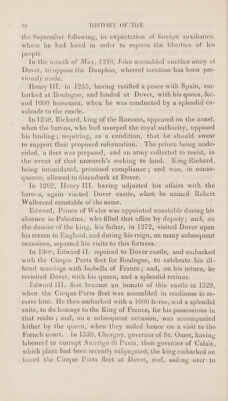
![the September following, in expectation of foreign auxiliaries, whom he had hired in order to repress the liberties of his people. In the month of May, 1216, John assembled ancther army at Dover, to oppose the Dauphin, whereof mention has been pre- viously made. Henry III. in 1255, having ratified a peace with Spain, em- barked at Boulogne, and landed at Dover, with his queen, &c. and 1000 horsemen, when he was conducted by a splendid ca- vaicade to the castle. In 1259, Richard, king of the Romans, appeared on the coast, when the barons, who had usurped the royal authority, opposed his landing; requiring, as a condition, that he should swear to support their proposed reformation. The prince being unde- cided, a fleet was prepared, and an army collected to resist, in the event of that monarch’s seeking to land. King Richard, being intimidated, promised compliance ; and was, in conse- quence, allowed to disembark at Dover. In 1262, Henry II]. having adjusted his affairs with the barons, again visited Dover castle, when he named Robert Wallerand constable of the same. Edward, Prince of Wales was appointed constable during his absence in Palestine, who filled that office by deputy; and, on the demise of the king, his father, in 1272, visited Dover upon his return to England, and during his reign, on many subsequent occasions, repeated his visits to this fortress. In 130s, Edward il. repaired to Dover castle, and embarked ‘with the Cinque Ports fleet for Boulogne, to celebrate his ill- fated marriage with Isabella of France; and, on his return, he revisited Dover, with his queen, and a splendid retinue. Edward ill. first became an inmate of this castle in 1329, when the Cinque Ports fleet was assembled in readiness to re- ceive him. He then embarked with a 1000 horse, and a splendid suite, to do homage to the King of France, for his possessions in that realm ; and, on a subsequent occasion, was accompanied hither by the queen, when they sailed hence on a visit to the French court. In 1039, Chargny, governor of St. Omer, having laboured to corrupt Amerigo di Pavia, then governor of Calais, which place had been recently subjugated, the king embarked on board the Cinque Ports fleet at Dover, and, sailing over. to](https://iiif.wellcomecollection.org/image/b33487765_0002_0048.jp2/full/800%2C/0/default.jpg)
 No text description is available for this image
 No text description is available for this image
 No text description is available for this image