Volume 2
England's topographer, or a new and complete history of the county of Kent; from the earliest records to the present time, including every modern improvement. Embellished with a series of views from original drawings by Geo. Shepherd, H. Gastineau, &c. with historical, topographical, critical, & biographical delineations / By W. H. Ireland.
- William Henry Ireland
- Date:
- 1828-1830
Licence: Public Domain Mark
Credit: England's topographer, or a new and complete history of the county of Kent; from the earliest records to the present time, including every modern improvement. Embellished with a series of views from original drawings by Geo. Shepherd, H. Gastineau, &c. with historical, topographical, critical, & biographical delineations / By W. H. Ireland. Source: Wellcome Collection.
50/800 page 38
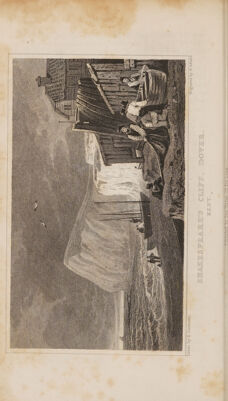
![who remained uatil the following day, when they departed for Canterbury. Henry VIII. then accompanied the emperor on. board his fleet, which had sailed to Sandwich, and subsequently returned to meet Queen Catherine at Dover castle. The two potentates then embarked to meet Francis I. between Guisnes and Ardres, afterwards called the Field of Gold Cloth, in con- sequence of the gorgeous display there exhibited. Henry fre- quently afterwards visited this castle, as before stated, and caused the erection of those of Sandown, Deal, Walmer, and Sandgate ; expending also large sums in repairing the harbour, and erecting bulwarks and block-houses at Dover. Queen Elizabeth, a.v. 1575, visited Dover castle, during her progress through the county of Kent; and expended large sums in reparations of the walls and towers. | On the 13th of June, 1625, Charles I. arrived here, and pro- vided apartments for the reception of Princess Henrietta Maria of France, whom he conducted to the castle ; after which, they proceeded to Canterbury, where the marriage was solemnized in the abbey of St. Augustine, as previously mentioned in our Mistory of that celebrated monastery. In February 1642, the above monarch and his queen, accom- panied by their daughter, Princess Mary, again visited Dover, having been expulsed, as one may say, from their throne, ‘with pecuniary resources barely equivalent for their necessities. Upon that occasion, the queen and her eldest daughter, then aged thirteen, embarked for Holland, Charles returning to Greenwich ; when, subsequently, the rebellion took place, which deprived him of his life and throne. On the Ist of August, 1642, Dover castle was wrested from its Jawful owner by one Blake, a merchant of the town, who, with only ten determined republicans, ventured to scale the tremendous cliff fronting the sea, in which direction no danger was to be ap- prehended from the garrison. Hasted describes this daring exploit in the following words : ‘So late as the civil commotions of King Charles the First’s reign, this castle attracted the attention of the leaders of both parties ; and, while the one endeavoured to keep, the other strove as constantly to gain, possession of it; but it was wrested. out of the king’s hands, being taken in 1642 by surprise, in the night, by one Drake, a merchant, and a zealous partizan for the ]](https://iiif.wellcomecollection.org/image/b33487765_0002_0050.jp2/full/800%2C/0/default.jpg)

 No text description is available for this image
 No text description is available for this image
 No text description is available for this image