Atlas of urinary sediments : with special reference to their clinical significance / by Hermann Rieder ; translated by Frederick Craven Moore ; edited and annotated by A. Sheridan Delépine.
- Hermann Rieder
- Date:
- 1899
Licence: Public Domain Mark
Credit: Atlas of urinary sediments : with special reference to their clinical significance / by Hermann Rieder ; translated by Frederick Craven Moore ; edited and annotated by A. Sheridan Delépine. Source: Wellcome Collection.
18/272
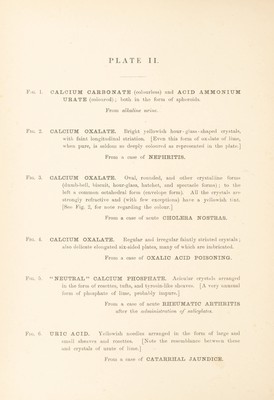
![Fig. 1. CALCIUM CARBONATE (colourless) and ACID AMMONIUM URATE (coloured) ; both in the form of spheroids. From alkaline urine. Fig. 2. CALCIUM OXALATE. Bright yellowish hour-glass - shaped crystals, with faint longitudinal striation. [Even this form of oxalate of lime, when pure, is seldom so deeply coloured as represented in the plate.] From a case of NEPHRITIS. Fig. 3. CALCIUM OXALATE. Oval, rounded, and other crystalline forms (dumb-bell, biscuit, hour-glass, hatchet, and spectacle forms) ; to the left a common octahedral form (envelope form). All the crystals are strongly refractive and (with few exceptions) have a yellowish tint. [See Fig. 2, for note regarding the colour.] From a case of acute CHOLERA NOSTRAS. Fig. 4. CALCIUM OXALATE. Regular and irregular faintly striated crystals ; also delicate elongated six-sided plates, many of which are imbricated. From a case of OXALIC ACID POISONING. Fig. 5. “ NEUTRAL99 CALCIUM PHOSPHATE. Acicular crystals arranged in the form of rosettes, tufts, and tyrosin-like sheaves. [A very unusual form of phosphate of lime, probably impure.] From a case of acute RHEUMATIC ARTHRITIS after the administration of salicylates. Fig. 6. URIC ACID. Yellowish needles arranged in the form of large and small sheaves and rosettes. [Note the resemblance between these and crystals of urate of lime.] From a case of CATARRHAL JAUNDICE.](https://iiif.wellcomecollection.org/image/b29309116_0018.jp2/full/800%2C/0/default.jpg)