Atlas of urinary sediments : with special reference to their clinical significance / by Hermann Rieder ; translated by Frederick Craven Moore ; edited and annotated by A. Sheridan Delépine.
- Hermann Rieder
- Date:
- 1899
Licence: Public Domain Mark
Credit: Atlas of urinary sediments : with special reference to their clinical significance / by Hermann Rieder ; translated by Frederick Craven Moore ; edited and annotated by A. Sheridan Delépine. Source: Wellcome Collection.
22/272
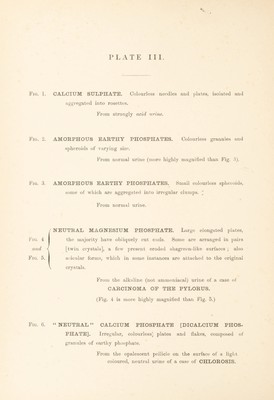
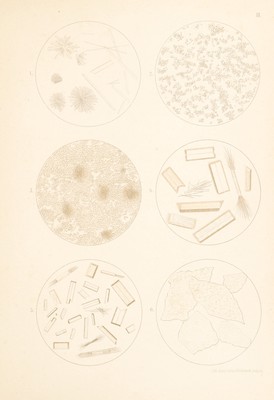
![Fig. 1. CALCIUM SULPHATE. Colourless needles and plates, isolated and aggregated into rosettes. From strongly acid urine. Fig. 2. AMORPHOUS EARTHY PHOSPHATES. Colourless granules and spheroids of varying size. From normal urine (more highly magnified than Fig. 3). Fig. 3. AMORPHOUS EARTHY PHOSPHATES. Small colourless spheroids, some of which are aggregated into irregular clumps. ‘‘ From normal urine. Fig. 4 and Fig. 5. / NEUTRAL MAGNESIUM PHOSPHATE. Large elongated plates, the majority have obliquely cut ends. Some are arranged in pairs < [twin crystals], a few present eroded shagreen-like surfaces ; also acicular forms, which in some instances are attached to the original \ crystals. From the alkaline (not ammoniacal) urine of a case of CARCINOMA OF THE PYLORUS. (Fig. 4 is more highly magnified than Fig. 5.) Fig. 6. “ NEUTRAL ” CALCIUM PHOSPHATE [DICALCIUM PHOS¬ PHATE]. Irregular, colourless] plates and flakes, composed of granules of earthy phosphate. From the opalescent pellicle on the surface of a light coloured, neutral urine of a case of CHLOROSIS.](https://iiif.wellcomecollection.org/image/b29309116_0022.jp2/full/800%2C/0/default.jpg)