Atlas of urinary sediments : with special reference to their clinical significance / by Hermann Rieder ; translated by Frederick Craven Moore ; edited and annotated by A. Sheridan Delépine.
- Hermann Rieder
- Date:
- 1899
Licence: Public Domain Mark
Credit: Atlas of urinary sediments : with special reference to their clinical significance / by Hermann Rieder ; translated by Frederick Craven Moore ; edited and annotated by A. Sheridan Delépine. Source: Wellcome Collection.
26/272
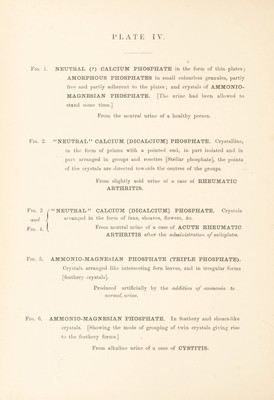
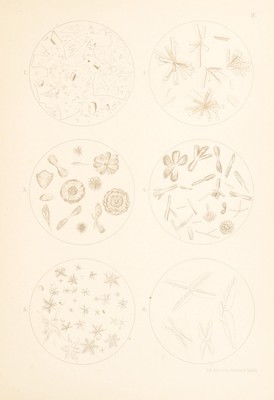
![Fig. 1. NEUTRAL (?) CALCIUM PHOSPHATE in the form of thin plates; AMORPHOUS PHOSPHATES in small colourless granules, partly free and partly adherent to the plates; and crystals of AMMONIO- M AGNESI AN PHOSPHATE. [The urine had been allowed to stand some time.] From the neutral urine of a healthy person. Fig. 2. “NEUTRAL” CALCIUM [DICALCIUM] PHOSPHATE. Crystalline, in the form of prisms with a pointed end, in part isolated and in part arranged in groups and rosettes [Stellar phosphate], the points of the crystals are directed towards the centres of the groups. From slightly acid urine of a case of RHEUMATIC ARTHRITIS. Fig. 3 and Fig. 4. “NEUTRAL” CALCIUM [DICALCIUM] PHOSPHATE. Crystals arranged in the form of fans, sheaves, flowers, &c. From neutral urine of a case of ACUTE RHEUMATIC ARTHRITIS after the administration of salicylates. Fig. 5. AMMONIO-MAGNESIAN PHOSPHATE (TRIPLE PHOSPHATE). Crystals arranged like intersecting fern leaves, and in irregular forms [feather}- crystals]. Produced artificially by the addition of ammonia to normal urine. Fig. 6. AMMONIO-MAGNESIAN PHOSPHATE. In feathery and shears-like crystals. [Showing the mode of grouping of twin crystals giving rise to the feathery forms.] From alkaline urine of a case of CYSTITIS.](https://iiif.wellcomecollection.org/image/b29309116_0026.jp2/full/800%2C/0/default.jpg)