Atlas of urinary sediments : with special reference to their clinical significance / by Hermann Rieder ; translated by Frederick Craven Moore ; edited and annotated by A. Sheridan Delépine.
- Hermann Rieder
- Date:
- 1899
Licence: Public Domain Mark
Credit: Atlas of urinary sediments : with special reference to their clinical significance / by Hermann Rieder ; translated by Frederick Craven Moore ; edited and annotated by A. Sheridan Delépine. Source: Wellcome Collection.
30/272
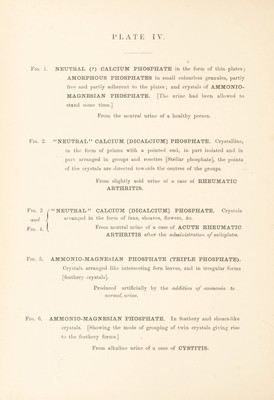
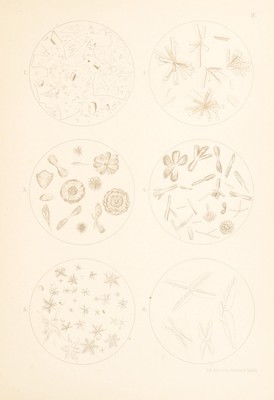
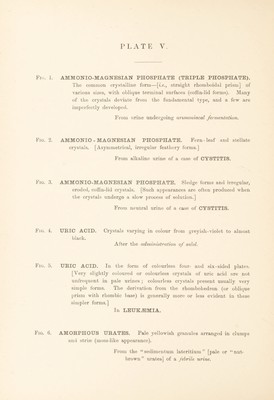
![FlG. 1 Fig. 2 Fig. 3. Fig. 4. Fig. 5. Fig. 6. AMMONIO-MAGNESIAN PHOSPHATE (TRIPLE PHOSPHATE). The common crystalline form—[i.e., straight rhomboidal prism] of various sizes, with oblique terminal surfaces (coffin-lid forms). Many of the crystals deviate from the fundamental type, and a few are imperfectly developed. From urine undergoing ammoniacal fermentation. AMMONIO-MAGNESIAN PHOSPHATE. Fern-leaf and stellate crystals. [Asymmetrical, irregular feathery forms.] From alkaline urine of a case of CYSTITIS. AMMONIO-MAGNESIAN PHOSPHATE. Sledge forms and irregular, eroded, coffin-lid crystals. [Such appearances are often produced when the crystals undergo a slow process of solution.] From neutral urine of a case of CYSTITIS. URIC ACID. black. Crystals varying in colour from greyish-violet to almost After the administration of salol. URIC ACID. In the form of colourless four- and six-sided plates. [Very slightly coloured or colourless crystals of uric acid are not unfrequent in pale urines ; colourless crystals present usually very simple forms. The derivation from the rhombohedron (or oblique prism with rhombic base) is generally more or less evident in these simpler forms.] In LEUKIEMIA. AMORPHOUS URATES. Pale yellowish granules arranged in clumps and striae (moss-like appearance). From the “ sedimentum lateritium ” [pale or “nut- brown ” urates] of a febrile urine.](https://iiif.wellcomecollection.org/image/b29309116_0030.jp2/full/800%2C/0/default.jpg)