Atlas of urinary sediments : with special reference to their clinical significance / by Hermann Rieder ; translated by Frederick Craven Moore ; edited and annotated by A. Sheridan Delépine.
- Hermann Rieder
- Date:
- 1899
Licence: Public Domain Mark
Credit: Atlas of urinary sediments : with special reference to their clinical significance / by Hermann Rieder ; translated by Frederick Craven Moore ; edited and annotated by A. Sheridan Delépine. Source: Wellcome Collection.
34/272
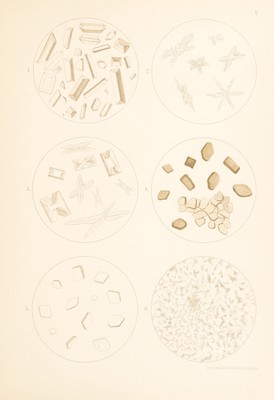
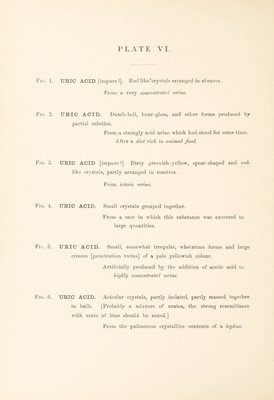
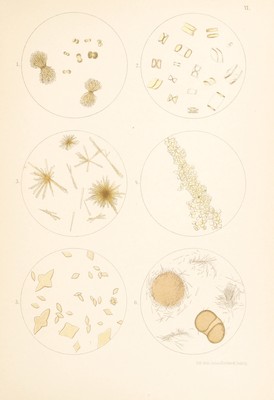
![Fig. 1. URIC ACID [impure1?]. Rod likecrystals arranged in sheaves. From a very concentrated urine. Fig. 2. URIC ACID. Dumb-bell, hour-glass, and other forms produced by partial solution. From a strongly acid urine which had stood for some time. After a diet rich in animal food. Fig. 3. URIC ACID [impure?] Dirty greenish-yellow, spear-shaped and rod¬ like crystals, partly arranged in rosettes. From icteric urine. Fig. 4. URIC ACID. Small crystals grouped together. From a case in which this substance was excreted in large quantities. Fig. 5. URIC ACID. Small, somewhat irregular, whetstone forms and large crosses [penetration twins] of a pale yellowish colour. Artificially produced by the addition of acetic acid to highly concentrated urine. Fig. 6. URIC ACID. Acicular crystals, partly isolated, partly massed together in balls. [Probably a mixture of urates, the strong resemblance with urate of lime should be noted.] From the pultaceous crystalline contents of a tophus.](https://iiif.wellcomecollection.org/image/b29309116_0034.jp2/full/800%2C/0/default.jpg)