Atlas of urinary sediments : with special reference to their clinical significance / by Hermann Rieder ; translated by Frederick Craven Moore ; edited and annotated by A. Sheridan Delépine.
- Hermann Rieder
- Date:
- 1899
Licence: Public Domain Mark
Credit: Atlas of urinary sediments : with special reference to their clinical significance / by Hermann Rieder ; translated by Frederick Craven Moore ; edited and annotated by A. Sheridan Delépine. Source: Wellcome Collection.
42/272
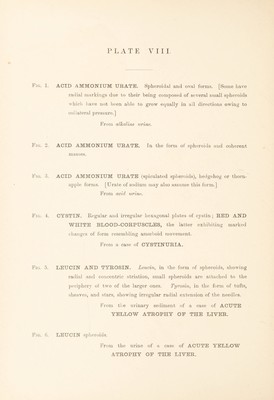
![Fig. 1. ACID AMMONIUM URATE. Spheroidal and oval forms. [Some have radial markings due to their being composed of several small spheroids which have not been able to grow equally in all directions owing to collateral pressure.] From alkaline urine. Fig. 2. ACID AMMONIUM URATE. In the form of spheroids and coherent masses. Fig. 3. ACID AMMONIUM URATE (spiculated spheroids), hedgehog or thorn- apple forms. [Urate of sodium may also assume this form.] From acid urine. Fig. 4. CYSTIN. Regular and irregular hexagonal plates of cystin; RED AND WHITE BLOOD-CORPUSCLES, the latter exhibiting marked chancres of form resembling amoeboid movement. o o From a case of CYSTINURIA. Fig. 5. LEUCIN AND TYROSIN. Leucin, in the form of spheroids, showing radial and concentric striation, small spheroids are attached to the periphery of two of the larger ones. Tyrosin, in the form of tufts, sheaves, and stars, showing irregular radial extension of the needles. From the urinary sediment of a case of ACUTE YELLOW ATROPHY OF THE LIVER. Fig. 6. LEUCIN spheroids. From the urine of a case of ACUTE YELLOW ATROPHY OF THE LIVER.](https://iiif.wellcomecollection.org/image/b29309116_0042.jp2/full/800%2C/0/default.jpg)