Atlas of urinary sediments : with special reference to their clinical significance / by Hermann Rieder ; translated by Frederick Craven Moore ; edited and annotated by A. Sheridan Delépine.
- Hermann Rieder
- Date:
- 1899
Licence: Public Domain Mark
Credit: Atlas of urinary sediments : with special reference to their clinical significance / by Hermann Rieder ; translated by Frederick Craven Moore ; edited and annotated by A. Sheridan Delépine. Source: Wellcome Collection.
54/272
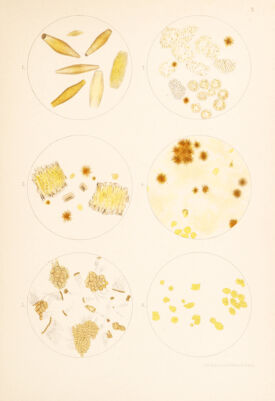
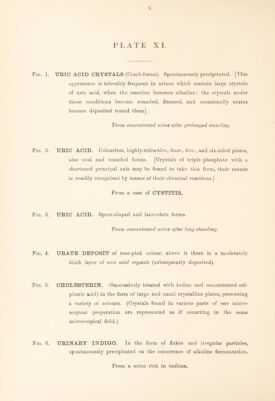
![Fig. 1 Fig. 2 Fig. 3 Fig. 4 Fig. 5. Fig. 6 URIC ACID CRYSTALS (Comb forms). Spontaneously precipitated. [This appearance is tolerably frequent in urines which contain large crystals of uric acid, when the reaction becomes alkaline; the crystals under those conditions become rounded, fissured, and occasionally urates become deposited round them]. From concentrated urine after prolonged standing. URIC ACID. Colourless, highly-refractive, four-, five-, and six-sided plates, also oval and rounded forms. [Crystals of triple phosphate with a shortened principal axis may be found to take this form, their nature is readily recognised by means of their chemical reactions.] From a case of CYSTITIS. URIC ACID. Spear-shaped and lanceolate forms. From concentrated urine after long standing. URATE DEPOSIT of rose-pink colour, above it there is a moderately thick layer of uric acid crystals (subsequently deposited). CHOLESTERIN. (Successively treated with iodine and concentrated sul¬ phuric acid) in the form of large and small crystalline plates, presenting a variety ot colours. (Crystals found in various parts of one micro¬ scopical preparation are represented as if occurring in the same microscopical field.) URINARY INDIGO. In the form of flakes and irregular particles, spontaneously precipitated on the occurrence of alkaline fermentation. From a urine rich in indican.](https://iiif.wellcomecollection.org/image/b29309116_0054.jp2/full/800%2C/0/default.jpg)


 No text description is available for this image
 No text description is available for this image
 No text description is available for this image