Atlas of urinary sediments : with special reference to their clinical significance / by Hermann Rieder ; translated by Frederick Craven Moore ; edited and annotated by A. Sheridan Delépine.
- Hermann Rieder
- Date:
- 1899
Licence: Public Domain Mark
Credit: Atlas of urinary sediments : with special reference to their clinical significance / by Hermann Rieder ; translated by Frederick Craven Moore ; edited and annotated by A. Sheridan Delépine. Source: Wellcome Collection.
58/272
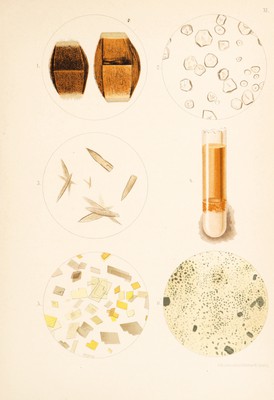
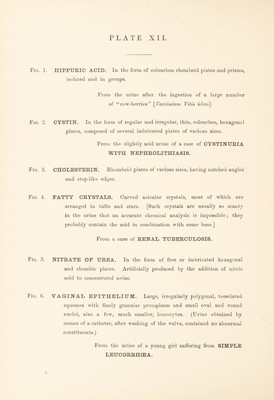
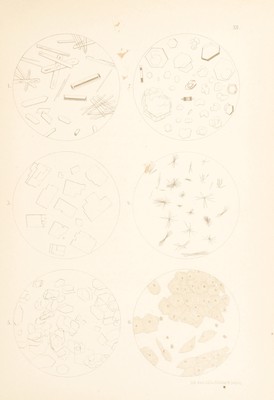
![Fig. 1 Fig. 2 Fig. 3. Fig. 4. Fig. 5. Fig. 6. HIPPURIC ACID. In the form of colourless rhomboid plates and prisms, isolated and in groups. From the urine after the ingestion of a large number of “cow-berries” [Vaccinium Vitis idcea\. CYSTIN. In the form of regular and irregular, thin, colourless, hexagonal plates, composed of several imbricated plates of various sizes. From the slightly acid urine of a case of CYSTINURIA WITH NEPHROLITHIASIS. CHOLESTERIN. Rhomboid plates of various sizes, having notched angles and step-like edges. FATTY CRYSTALS. Curved acicular crystals, most of which are arranged in tufts and stars. [Such crystals are usually so scanty in the urine that an accurate chemical analysis is impossible; they probably contain the acid in combination with some base.] From a case of RENAL TUBERCULOSIS. NITRATE OF UREA. In the form of free or imbricated hexagonal and rhombic plates. Artificially produced by the addition of nitric acid to concentrated urine. VAGINAL EPITHELIUM. Large, irregularly polygonal, tesselated squames with finely granular protoplasm and small oval and round nuclei, also a few, much smaller, leucocytes. (Urine obtained by means of a catheter, after washing of the vulva, contained no abnormal constituents.) From the urine of a young girl suffering from SIMPLE LEUCORRHCEA.](https://iiif.wellcomecollection.org/image/b29309116_0058.jp2/full/800%2C/0/default.jpg)