Atlas of urinary sediments : with special reference to their clinical significance / by Hermann Rieder ; translated by Frederick Craven Moore ; edited and annotated by A. Sheridan Delépine.
- Hermann Rieder
- Date:
- 1899
Licence: Public Domain Mark
Credit: Atlas of urinary sediments : with special reference to their clinical significance / by Hermann Rieder ; translated by Frederick Craven Moore ; edited and annotated by A. Sheridan Delépine. Source: Wellcome Collection.
66/272
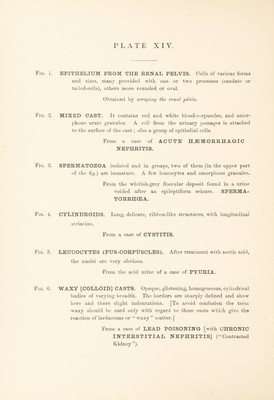
![Fig. 1 Fig. 2 Fig. 3. Fig. 4. Fig. 5. Fig. 6. EPITHELIUM FROM THE RENAL PELVIS. Cells of various forms and sizes, many provided with one or two processes (caudate or tailed-cells), others more rounded or oval. Obtained by scraping the renal pelvis. MIXED CAST. It contains red and white blood-corpuscles, and amor¬ phous urate granules. A cell from the urinary passages is attached to the surface of the cast; also a group of epithelial cells. From a case of ACUTE HEMORRHAGIC NEPHRITIS. SPERMATOZOA isolated and in groups, two of them (in the upper part of the fig.) are immature. A few leucocytes and amorphous granules. From the whitish-grey floccular deposit found in a urine voided after an epileptiform seizure. SPERMA¬ TORRHOEA. CYLINDROIDS. Long, delicate, ribbon-like structures, with longitudinal striation. From a case of CYSTITIS. LEUCOCYTES (PUS-CORPUSCLES). After treatment with acetic acid, the nuclei are very obvious. From the acid urine of a case of PYURIA. WAXY [COLLOID] CASTS. Opaque, glistening, homogeneous, cylindrical bodies of varying breadth. The borders are sharply defined and show here and there slight indentations. [To avoid confusion the term waxy should be used only with regard to those casts which give the reaction of lardaceous or “ waxy” matter.] From a case of LEAD POISONING [with CHRONIC INTERSTITIAL NEPHRITIS] (“Contracted Kidney ”).](https://iiif.wellcomecollection.org/image/b29309116_0066.jp2/full/800%2C/0/default.jpg)