The evolution of sex / by Professor Patrick Geddes and J. Arthur Thomson.
- Patrick Geddes
- Date:
- [1900]
Licence: Attribution-NonCommercial 4.0 International (CC BY-NC 4.0)
Credit: The evolution of sex / by Professor Patrick Geddes and J. Arthur Thomson. Source: Wellcome Collection.
271/366 (page 251)
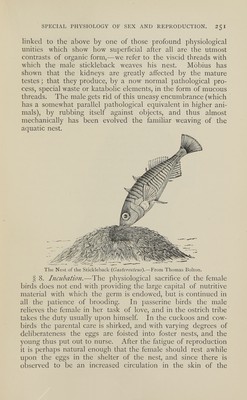
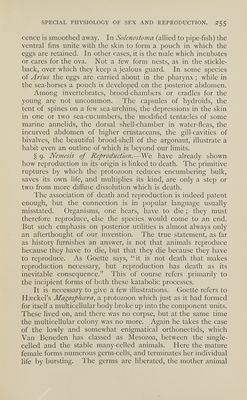
![SPECIAL PHYSIOLOGY OF SEX AND REPRODUCTION. 251 linked to the above by one of those profound physiological unities which show how superficial after all are the utmost contrasts of organic form,—we refer to the viscid threads with which the male stickleback weaves his nest. Möbius has shown that the kidneys are greatly affected by the mature testes ; that they produce, by a now normal pathological pro¬ cess, special waste or katabolic elements, in the form of mucous threads. The male gets rid of this uneasy encumbrance (which has a somewhat parallel pathological equivalent in higher ani¬ mals), by rubbing itself against objects, and thus almost mechanically has been evolved the familiar weaving of the aquatic nest. The Nest of the Stickleback (Gasterosteus).—From Thomas Bolton. § 8. Incubation.—-The physiological sacrifice of the female birds does not end \vith providing the large capital of nutritive material with which the germ is endowed, but is continued in all the patience of brooding. In ])asserine birds the male relieves the female in her task of love, and in the ostrich tribe takes the duty usually upon himself. In the cuckoos and cow- birds the parental care is shirked, and with varying degrees of deliberateness the eggs are foisted into foster nests, and the young thus put out to nurse. After the fatigue of reproduction it is perhaps natural enough that the female should rest awhile upon the eggs in the shelter of the nest, and since there is observed to be an increased circulation in the skin of the](https://iiif.wellcomecollection.org/image/b18027234_0272.JP2/full/800%2C/0/default.jpg)