The evolution of sex / by Professor Patrick Geddes and J. Arthur Thomson.
- Patrick Geddes
- Date:
- [1900]
Licence: Attribution-NonCommercial 4.0 International (CC BY-NC 4.0)
Credit: The evolution of sex / by Professor Patrick Geddes and J. Arthur Thomson. Source: Wellcome Collection.
281/366 (page 261)
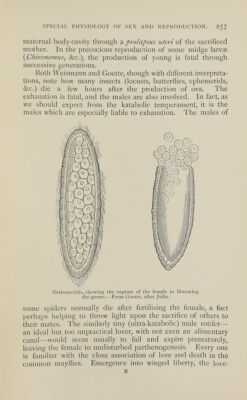
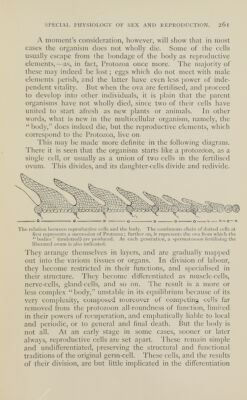
![SPECIAL PHYSIOLOGY OF SEX AND REPRODUCTION. 201 A moment's consideration, however, will show that in most cases the organism does not wholly die. Some of the cells usually escape from the bondage of the body as reproductive elements,—as, in fact, Protozoa once more. The majority of these may indeed be lost ; eggs which do not meet with male elements perish, and the latter have even less power of inde¬ pendent vitality. But when the ova are fertilised, and proceed to develop into other individuals, it is plain that the parent organisms have not wholly died, since two of their cells have united to start afresh as new plants or animals. In other words, what is new in the multicellular organism, namely, the body, does indeed die, but the reproductive elements, which correspond to the Protozoa, live on. This may be made more definite in the following diagram. There it is seen that the organism starts like a protozoon, as a single cell, or usually as a union of two cells in the fertilised ovum. This divides, and its daughter-cells divide and redivide. The relation between reproductive cells and the body. The continuous chain of dotted cells at first represents a succession of Protozoa ; further on, it represents the ova from which the *M)odies (undotted) are produced. At each generation, a spermatozoon fertihsing the liberated ovum is also indicated. They arrange themselves in layers, and are gradually mapped out into the various tissues or organs. In division of labour, they become restricted in their functions, and specialised in their structure. They become differentiated as muscle-cells, nerve-cells, gland-cells, and so on. The result is a more or less complex body, unstable in its equilibrium because of its very complexity, composed moreover of competing cells far removed from the protozoon all-roundness of function, limited in their powers of recuperation, and emphatically liable to local and periodic, or to general and final death. But the body is not all. At an early stage in some cases, sooner or later always, reproductive cells are set apart. These remain simple and undifferentiated, ])reserving the structural and functional traditions of the original germ-cell. These cells, and the results of their division, are but little implicated in the differentiation](https://iiif.wellcomecollection.org/image/b18027234_0282.JP2/full/800%2C/0/default.jpg)