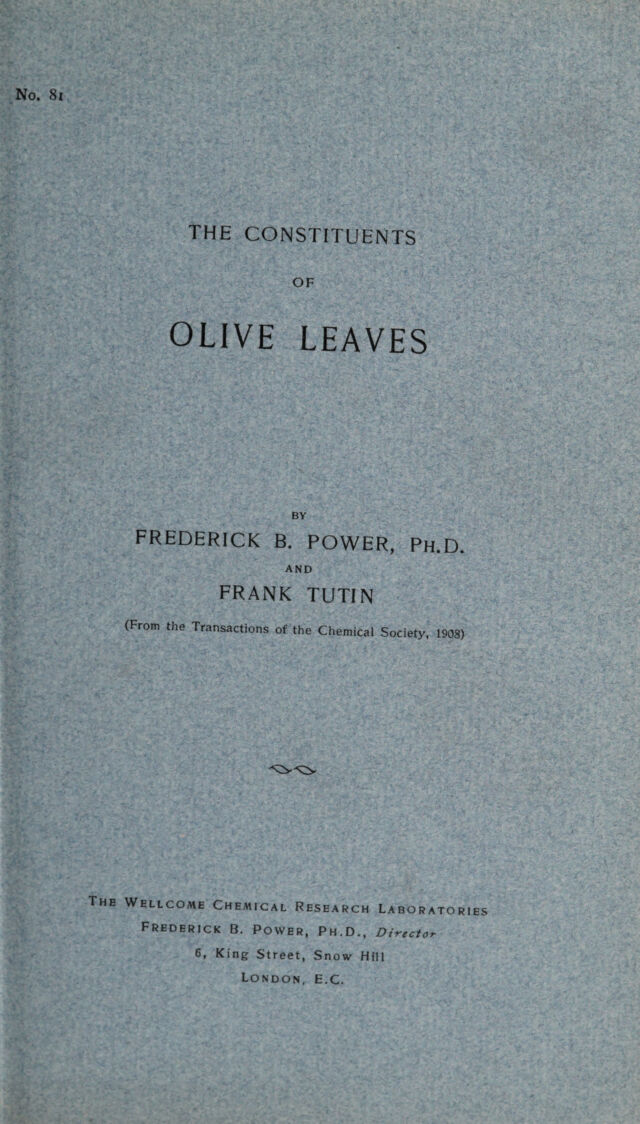
The constituents of olive leaves / by Frederick B. Power and Frank Tutin.
- Frederick Belding Power
- Date:
- [1908?]
Licence: In copyright
Credit: The constituents of olive leaves / by Frederick B. Power and Frank Tutin. Source: Wellcome Collection.
14/18 page 902
![A determination of the specific rotatory power of homo-olestranol yielded the following result : 0*7216, dissolved in 25 c.c. of chloroform, gave aD + 4°6' in a 2-dcm. tube, whence [a]D +71*0°. The amount of olestranol available did not permit of a similar determination being made with that compound. Chloroform, Ethyl Acetate, and Alcohol Extracts of the Resin. The chloroform extract of the resin amounted to 9 grams. It was exhaustively examined, but nothing crystalline could be obtained from it. The portion of the resin extracted by ethyl acetate amounted to only 2 grams. It consisted of tarry matter, together with a trace of cZ-mannitol, which was subsequently isolated in larger amount from the aqueous liquid. The remainder of the resin, which was soluble only in alcohol, formed a brown powder, and amounted to 23 grams. Nothing crystal¬ line could be separated from it, and, in view of the possibility of its containing some glucosidic material, it was freed from any traces of sugar and submitted to the action of sulphuric acid in dilute alcohol, but was unaltered by this treatment. Examination of the Brown Resin (B). This product, obtained as previously described, amounted to 47 grams. It was mixed with purified sawdust,and extracted with the same solvents as were employed in the case of the green resin. The petroleum and ethereal extracts thus obtained were small in amount, and consisted chiefly of the material which formed the corresponding extracts from the resin previously examined. The remaining extracts, of which that obtained by ethyl acetate was the largest, were all brown, resinous products, from which nothing crystalline could be isolated. Examination of the Aqueous Liquid (C). After concentrating this liquid, it was extracted many times with ether, but this removed only a small amount of amorphous material, containing but a trace of crystalline substance. An excess of a solution of basic lead acetate was then added, when a bulky, yellow precipitate was produced, which was removed by filtration and thoroughly washed with boiling water. This precipitate was suspended in water, decom¬ posed by hydrogen sulphide, and the mixture filtered. The filtrate was concentrated and allowed to cool, when a quantity of brown, viscid, resinous matter separated. The clear liquid was then ex-](https://iiif.wellcomecollection.org/image/b30613152_0014.jp2/full/800%2C/0/default.jpg)