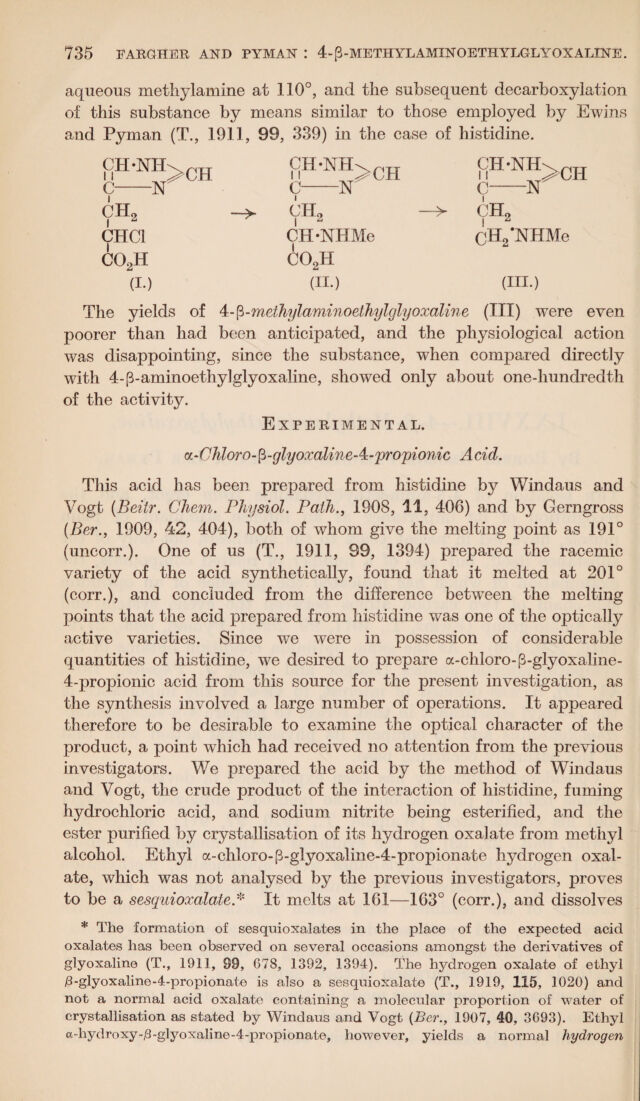
4-beta-Methylaminoethylglyoxaline / by Robert George Fargher and Frank Lee Pyman.
- Fargher, Robert George.
- Date:
- 1921.]
Licence: Public Domain Mark
Credit: 4-beta-Methylaminoethylglyoxaline / by Robert George Fargher and Frank Lee Pyman. Source: Wellcome Collection.
3/8 page 736
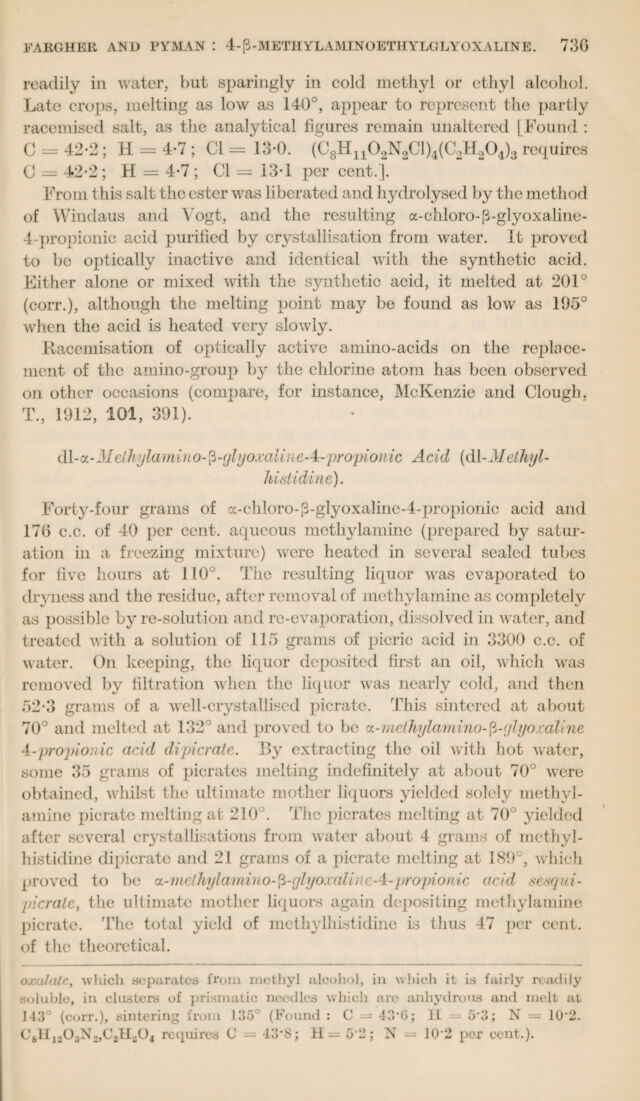
![readily in water, but sparingly in cold methyl or ethyl alcohol. Late crops, melting as low as 140°, appear to represent the partly racemised salt, as the analytical figures remain unaltered [Found : C = 42-2 ; H = 4-7; Cl = 13-0. (C8Hn02N2Cl)4(C2H204)3 requires C = 42*2 ; H = 4-7 ; Cl = 13-1 per cent.]. From this salt the ester was liberated and hydrolysed by the method of Windaus and Vogt, and the resulting a-chloro-p-glyoxaline- 4-propionic acid purified by crystallisation from water. It proved to be optically inactive and identical with the synthetic acid. Either alone or mixed with the synthetic acid, it melted at 201° (coit.), although the melting point may be found as low as 195° when the acid is heated very slowly. Racemisation of optically active amino-acids on the replace¬ ment of the amino-group by the chlorine atom has been observed on other occasions (compare, for instance, McKenzie and Clough, T., 1912, 101, 391). dl-oL-Methylamino-$-glyoxaline A-propionic Acid (dethyl- histidine) . Forty-four grams of a-chloro-p-glyoxalinc-4-propionic acid arid 176 c.c. of 40 per cent, aqueous mcthylamine (prepared by satur¬ ation in a freezing mixture) were heated in several sealed tubes for five hours at 110°. The resulting liquor was evaporated to dryness and the residue, after removal of mcthylamine as completely as possible byre-solution and re-evaporation, dissolved in water, and treated with a solution of 115 grams of picric acid in 3300 c.c. of water. On keeping, the liquor deposited first an oil, which was removed by filtration when the liquor was nearly cold, and then 52-3 grams of a well-crystallised picrate. This sintered at about 70° and melted at 132° and proved to be cL-methylamino-fi-glyoxallne 4-propionic acid di picrate. By extracting the oil with hot water, some 35 grams of pierates melting indefinitely at about 70° were obtained, whilst the ultimate mother liquors yielded solely methyl- amine picrate melting at 210°. The pierates melting at 70° yielded after several crystallisations from water about 4 grams of methyl- histidine dipicrate and 21 grams of a picrate melting at 189°, which proved to be a-methyl a mino-$-glyoxali)ieA-propion ic acid sesqui- picrate, the ultimate mother liquors again depositing mcthylamine picrate. The total yield of methylhistidine is thus 47 per cent, of the theoretical. oxalate, which separates from methyl alcohol, in which it is faii-ly readily soluble, in clusters of prismatic needles which are anhydrous and melt at 143° (corr.), sintering from 135° (Found : C = 43'G; II — 5‘3; N = 10*2. C8H1103N2,C2Ha04 requires (J = 43‘S; H= 0*2; N = 10’2 per cent.).](https://iiif.wellcomecollection.org/image/b30622992_0003.jp2/full/800%2C/0/default.jpg)