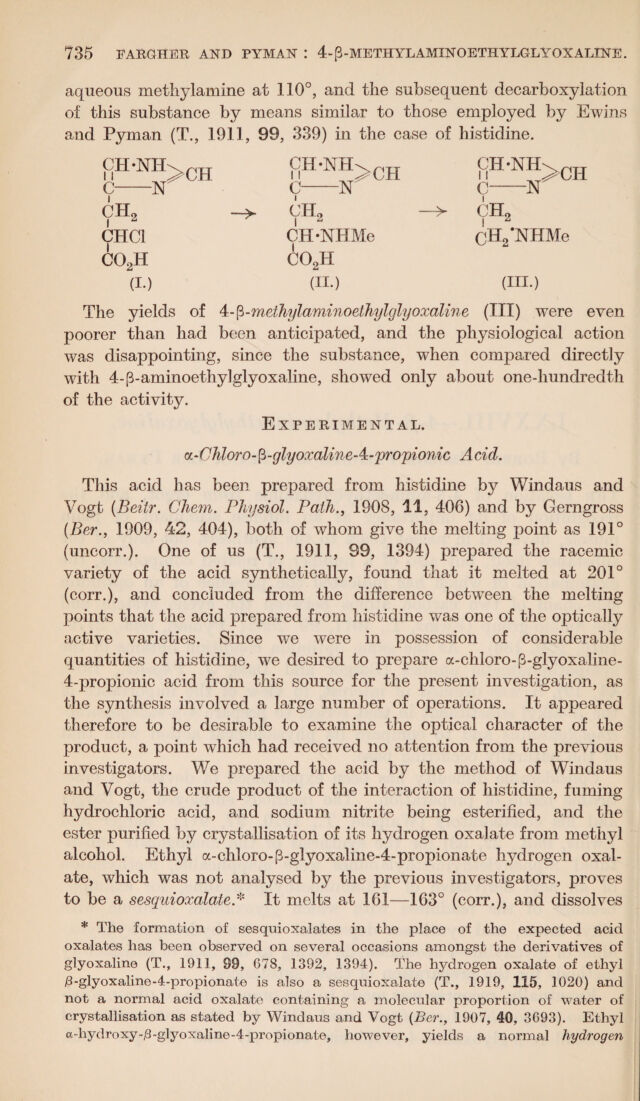
4-beta-Methylaminoethylglyoxaline / by Robert George Fargher and Frank Lee Pyman.
- Fargher, Robert George.
- Date:
- 1921.]
Licence: Public Domain Mark
Credit: 4-beta-Methylaminoethylglyoxaline / by Robert George Fargher and Frank Lee Pyman. Source: Wellcome Collection.
5/8 page 738
![which is not lost on heating at 60° in a vacuum. The solution in sodium carbonate gives a blood-red colour with sodium diazo- benzcne-p-sulphonate (Found : loss in a vacuum at G0° = 1-2 per cent. In dried material, C = 32-5; H = 5-6; N = 15*9; Cl = 26-9. C7H310.>N3,2HC1,Ho0 requires C = 32*3; H = 5-8; N = 10*1; Cl = 27-3 per cent.*). cL-Methylamino-fi-glyoxaline-4:-propionic acid aurichloride separ¬ ates from water, in which it is only sparingly soluble, in glistening, pale orange, flattened prisms, which are anhydrous and effervesce at 115° (corr.) without melting (Found : Au = 46*7. C7H1102N3,2HC1,2AuC13 requires Au = 46*4 per cent.). oL-Methylamino-ft-glyoxalineA-propioiiic acid is prepared by digesting an aqueous solution of the hydrochloride with slightly more than the quantity of silver carbonate calculated to remove the hydrochloric acid completely. It separates from the resulting solution, after concentration, in needles, which melt and effervesce at 270° (corr.), arc anhydrous, and taste sweet with a bitter after¬ taste (Loss at 110° =1*3 per cent. Found : in dried material, C = 49*5; H = 6*5; N = 24*5. C7Hn02N3 requires C = 49*7 ; H = 6*6; N = 24*8 per cent.). The benzoyl derivative, obtained by the Schotten-Baumann method, separates from water, in which it is much more readily soluble than the corresponding histidine derivative, in clusters of minute prisms, which give an intense red coloration with sodium diazobenzene-p-sulphonate in sodium carbonate solution. The air- dried material retains one-half of a molecular proportion of water of crystallisation, which is lost at 110°. It melts and effervesces at 241° (corr.) [Found : in air-dried material, C = 59*5; H = 5*6; loss at 110° = 2*9. (C14H1503N3)o,H20 requires C = 59*5; II = 5*7 ; H20 = 3*2 per cent.]. 4-p-M ethylamm oelhylglyoxaline. This base can be prepared in poor yield by the decarboxylation of the preceding benzoyl derivative and hydrolysis of the product or by decarboxylation of methylhistidine by means of 20 per cent, hydrochloric acid at 280°. Unlike the parent base (compare Ewins and Pyman, loc. cit.), it cannot be prepared by the action of 20 per cent, sulphuric acid on methylhistidine, the reaction resulting in almost complete decomposition of the methylhistidine and reduc¬ tion of the sulphuric acid to hydrogen sulphide at temperatures of 270—290°, whilst below 270° little decarboxylation occurs. (a) Formation of 4c-$-Methylaminoethylglyoxaline from Benzoyl- methylhistidine.—1*2 Grams of benzoylmethylhistidine were heated](https://iiif.wellcomecollection.org/image/b30622992_0005.jp2/full/800%2C/0/default.jpg)