Engineering in relation to hygiene.
- International Congress of Hygiene and Demography
- Date:
- 1892
Licence: Public Domain Mark
Credit: Engineering in relation to hygiene. Source: Wellcome Collection.
Provider: This material has been provided by London School of Hygiene & Tropical Medicine Library & Archives Service. The original may be consulted at London School of Hygiene & Tropical Medicine Library & Archives Service.
260/272 page 260
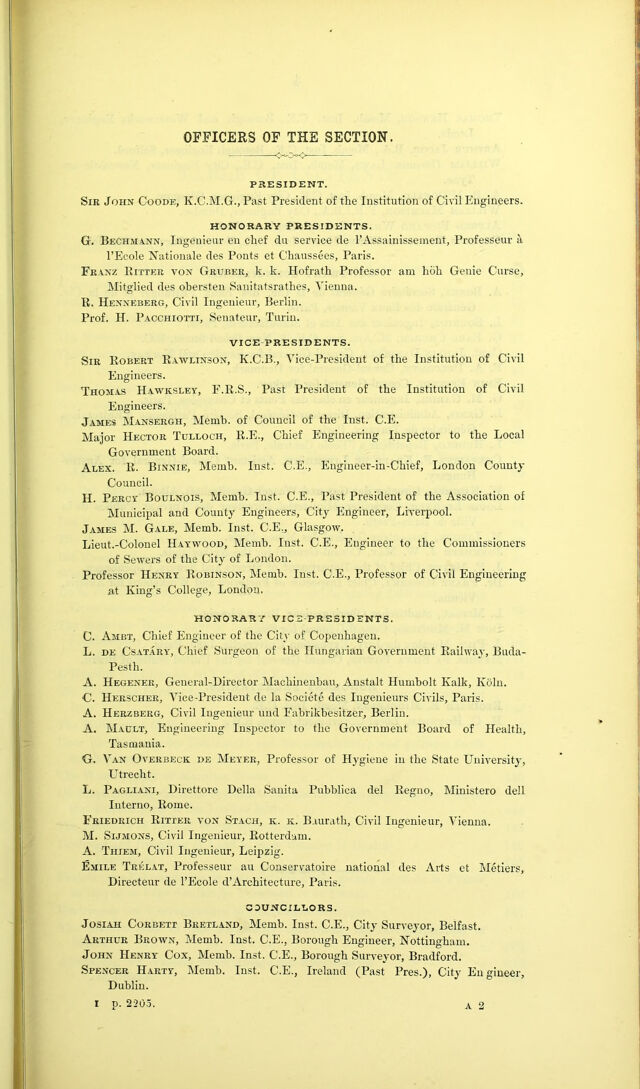
![11. L’exce.ssive huinidite du sous-sol s’evitera dans les villes qu’aient cet inconvenient an iiioyen du drainage permeable dispose sur les cotes du reseau des egouts. 12. La depuration agricolc complete rassainissement du sous-sol des villes, constituant, cpiand on pent I’appliquer opportunement, le moyen le plus liigienique et economique de tons les systemes connus. ^-=ooo-< DISCUSSION. The President said they must now close their proceedings for the day and for the Session. He should like to express the thanks of the committee to those gentlemen who had come so far and rendered such valuable services in the presenting and discussing of the several papers. He should, be sorry for them to dissolve without according to their in- valuable secretary, Mr. Middleton, their best thanks for the services he had rendered. There was no member of the Organising Committee or of the Council, or of the Sectional Committee, there was no gentleman in' the room or out of it who was so able to judge as he was, owing to the ])eculiar circumstances in which he had been placed as President of the Section, or who could form an adequate conception of the value of Mr. Middleton’s services from the very commencement of the work, several months ago, until the present time. He hoped they would give him a vote of thanks by acclamation for the services he had rendered. A vote of thanks to Mr. Middleton for his services as secretary was then carried Ijy acclamation. Mr. Middleton said he was exceedingly obliged to them for the- manner in which they had received the remarks of Sir John Coode. He could .say that, although the duties of the secretarj'ship of that section had been heavy, they had been a labour of love. Ho o?rly hoped that his work had been properly done, and that they were satisfied with it; if so,, he was well repaid. The President said the next stage would be that in course of time members would receive the report of their proceedings in print. He thought he was justified in saying that the result of that gathering in London had not been surpassed in value by those of any other meetings of the Congress in any other city in Europe. Mr. Middleton said that in the absence of the vice-presidents he hoped he might be allowed to propose a hearty vote of thanks to Sir John Coode, who had given up an immense amount of his valuable time to presiding at the meetings, much more even than could have been expected from him. They were very much obliged to him for the trouble he had taken in attending not only these meetings, but the meetings of the committee. The organisation of the scheme could not have gone on in the way it had, if Sir John Coode had not given so large an amount of attention to it. A vote of thanks was then passed to the President by acclamation. The President said he had endeavoured to do that, as every other matter which he took in hand, to the best of his power, not putting his hand to the plough and looking back. He thanked them for the recognition they had tendered to him for so doing.](https://iiif.wellcomecollection.org/image/b28045427_0262.jp2/full/800%2C/0/default.jpg)