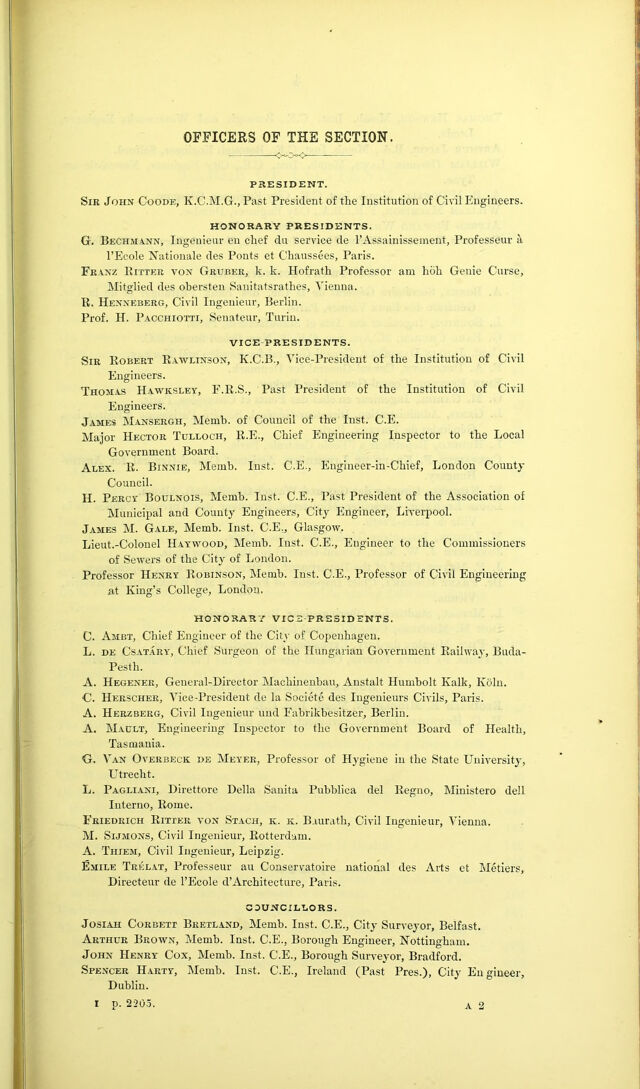
Engineering in relation to hygiene.
- International Congress of Hygiene and Demography
- Date:
- 1892
Licence: Public Domain Mark
Credit: Engineering in relation to hygiene. Source: Wellcome Collection.
Provider: This material has been provided by London School of Hygiene & Tropical Medicine Library & Archives Service. The original may be consulted at London School of Hygiene & Tropical Medicine Library & Archives Service.
9/272 page 9
![As Ji matter which cannot fail to be of special interest to engineers, let ns turn for a moment and see what has been done in the way of works that have been executed for the special purpose of improving the health of London. The main intercepting and principal branch sewers which have been constructed for the conveyance of the sewage of London to the two outfalls into the Liver Thames, at Barking and Crossness respectively, measure about 80 English miles, equal to 130 kilometres. Since the year 1856, when the now extinct Metropolitan Board of Works” was formed, there has been expended on the main drainage works alone the sum of nearly 6,000,000/. [120,000,000 marks or 150.000. 000 francs]. As a by no means unimportant factor among the changes which, in modern times, have resulted in the better health of our capital city, a reference to the supply of water of improved qualitj-, and in larger quantity, must not be altogether omitted. Up to the end of 1890 the several companies (eight in number) had expended upon works for the supply of water to London, a sum very closely approximating to 15.000. 000/. [300,000,000 marks or 375,000,000 francs]. The average quantity of water delivered last year to the inhabitants of London, for domestic purposes alone, was 24‘75 gallons per head of population per diem, and in point of (juality but little, if at all, surpassed by that supplied to any other city in Europe; this water is conveyed through pipes, the united length of which is about 4,760 miles. The total volume of water delivered for domestic purposes only in 1890 was 64,000,000,000 gallons [290,623,000 cubic metres]. For raising this large quantity the companies employed no less than 184 steam pumping engines, having an aggregate of 21,659 horse- power. I may here make a passing remark with regard to this large (luantity, upwards of 21,000 horse power. As you all know, six hours a day of continuous work is good work for a horse; therefore in that view this quantity might be multiplied by four, making it 80,000 horse power. That is not quite correct, because during the night these pumping engines slow down to some extent; but you may multiply the 21,000 by three. Supposing you were to employ animals to do that amount of work you would require over 60,000 horses to pump the water daily required for London ; that it is from two-and-a-half to three times the number of horses in the entire British Army, both at home and abroad. Taking that fact into consideration, it will assist in giving some idea of the labour involved in supplying water alone to this great city of ours. As another illustration of the magnitude of London it may be mentioned that the streets and roads within the Metropolis, if placed end to end in one continuous line, would measure about 2,500 miles, equal to the distance from London to Land’s End, and thence across the Atlantic Ocean to the mouth of the Gulf of St. Lawrence in Canada on the west, or, going eastward, would extend across the entire Continent of Europe, and beyond the Ural Mountains into Asia.](https://iiif.wellcomecollection.org/image/b28045427_0011.jp2/full/800%2C/0/default.jpg)