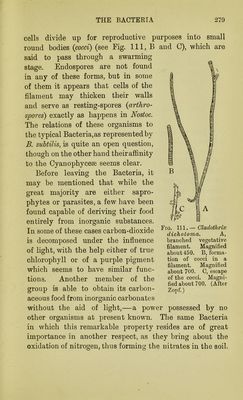
An introduction to structural botany. Pt. II, Flowerless plants / by Dukinfield Henry Scott.
- Dukinfield Henry Scott
- Date:
- 1904
Licence: In copyright
Credit: An introduction to structural botany. Pt. II, Flowerless plants / by Dukinfield Henry Scott. Source: Wellcome Collection.
300/340 (page 280)
![CHAPTEE VI THE MYXOMYCETES1 Our last type represents a group of organisms lying on the borderland of the animal and vegetable kingdoms. It may be doubted whether they have any right to a place in a book on botany, but we give them the benefit of the doubt because of their great scientific interest; for in them we can study living protoplasm and its behaviour on a greater scale than in any other creatures Myxomycetes, unlike Fungi and Bacteria, are of no practical importance, and are probably known to very few people except naturalists; yet they are common enough, easily visible to the naked eye, and in some conditions extremely conspicuous. In the vegetative state a typical Myxomycete consists of a mass of naked protoplasm, sometimes several inches in extent, which creeps slowly about, on the surface of dead leaves or bark or wood. Such immense aggrega- tions of living matter in so simple a form are quite unknown in any other group of organisms. When reproduction is about to take place, the creature completely changes its character, gradually ceases to be active, and converts itself into a collection of fruits of rather complex structure, in which the microscopic spores Also called Myceto oa. ]](https://iiif.wellcomecollection.org/image/b28134576_0300.jp2/full/800%2C/0/default.jpg)