Some account of the last yellow fever epidemic of British Guiana / by Daniel Blair, surgeon general of British Guiana ; edited by John Davy, inspector general of army hospitals, etc.
- Blair, Daniel.
- Date:
- 1852
Licence: Public Domain Mark
Credit: Some account of the last yellow fever epidemic of British Guiana / by Daniel Blair, surgeon general of British Guiana ; edited by John Davy, inspector general of army hospitals, etc. Source: Wellcome Collection.
Provider: This material has been provided by King’s College London. The original may be consulted at King’s College London.
27/290 (page 5)
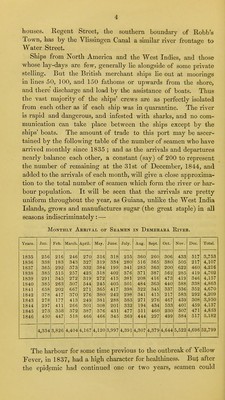
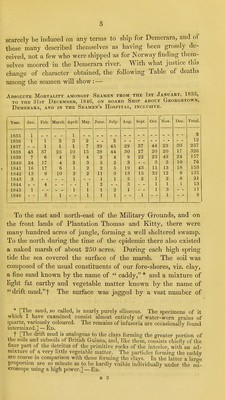
![scarcely be induced on any terms to slnp for Dcmerara, and of these many described themselves as having been grossly de- ceived, not a few who were shipped as for Norway finding them- selves moored in the Demerara river. With what justice this change of character obtained, the following Table of deaths amone: the seamen will show : — Absolute Mortamty amongst Seamen from the 1st January, 1835, TO the 31st December, 1846, on board Ship about Georgetown, Demerara, and in the Seamen's Hospital, inclusive. Year. Jan. Feb. March. April. May. June. July. Aug. Sept. Oct. 'Nov. Dec. Total. 1835 1 1 2 1836 1 1 3 3 2 2 12 1837 1 1 1 7 39 45 29 37 44 23 30 257 1838 43 37 25 10 15 38 44 30 27 20 20 17 326 1839 7 6 4 3 4 2 4 9 22 23 49 24 157 1840 24 17 4 2 3 5 2 3 3 3 10 76 1841 16 17 6 1 2 2 5 19 43 11 13 18 153 1842 13 8 10 2 2 11 9 13 15 32 12 8 135 1843 3 1 1 1 2 2 1 2 8 21 1844 4 1 2 3 I I 1 13 1845 1 1 1 1 2 1 1 3 11 1846 3 1 1 1 1 1 1 9 To the east and north-east of the Military Grounds, and on the front lands of Plantation Thomas and Kitty, there were many hundred acres of jungle, forming a w^ell sheltered swamp. To the north during the time of the epidemic there also existed a naked marsh of about 250 acres. During each high spring tide the sea covered the surface of the marsh. The soil was composed of the usual constituents of our fore-shores, viz. clay, a fine sand known by the name of caddy, * and a mixture of light fat earthy and vegetable matter known by the name of drift mud.t The surface was jagged by a vast number of * [The sand, so called, is nearly purely siliceous. The specimens of it which I have examined consist almost entirely of water-worn grains of cjuartz, variously coloured. The remains of infusoria are occasionally found intermixed.] — Ed. t [The drift mud is analogous to the clays forming the greater portion of the soils and subsoils of British Guiana, and, like them, consists chiefly of the finer part of the detritus of the primitive rocks of the interior, with an ad- mixture of a very little vegetable matter. The particles forming the caddy are coarse in comparison with those forming the clays. In the latter a large proportion are so minute as to be hardly v'isiblc individually under the mi- croscope using a high power.] —Ed.](https://iiif.wellcomecollection.org/image/b2129799x_0027.jp2/full/800%2C/0/default.jpg)